
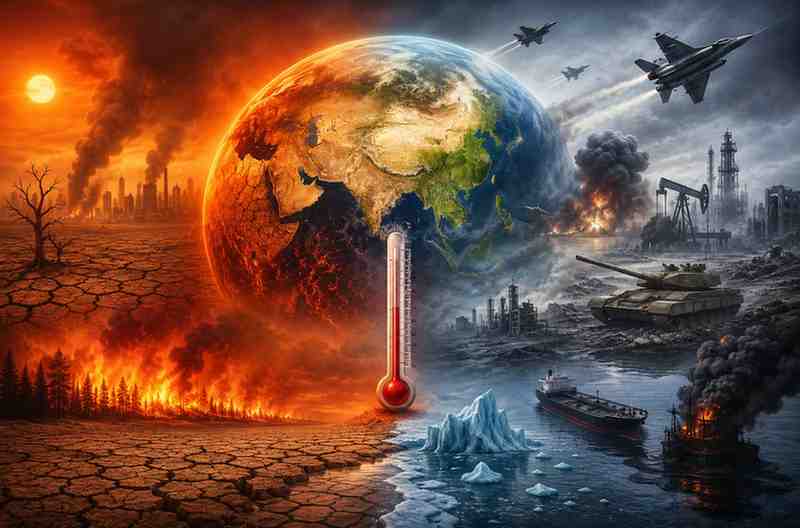
Global warming is driving unprecedented heatwaves, devastating wildfires, and record-breaking temperatures across the world, raising an important question: Are ongoing conflicts, particularly the Russia-Ukraine war and the recent military confrontation between the United States and Iran, further accelerating the planet’s warming?
Climate scientists agree that the primary driver of global warming remains the burning of fossil fuels, deforestation, and industrial emissions. However, modern warfare is increasingly being recognized as an overlooked contributor to environmental degradation and greenhouse gas emissions. While wars alone are not responsible for the planet’s rising temperatures, they amplify an already critical climate crisis.
The Main Cause of Rising Global Temperatures
The Earth’s average temperature has already increased by around 1.2°C since the pre-industrial era. Carbon dioxide, methane, and other greenhouse gases released from coal-fired power plants, oil refineries, vehicles, factories, and agricultural activities continue to trap heat in the atmosphere.
Scientists warn that every additional fraction of a degree increases the likelihood of deadly heatwaves, stronger storms, prolonged droughts, crop failures, and rising sea levels. These long-term emissions remain the dominant force behind global warming.
How Modern Warfare Impacts the Environment
Military conflicts generate a significant environmental footprint. Fighter jets, tanks, warships, missiles, and military transport vehicles consume enormous quantities of fossil fuels. Bombardments often ignite oil depots, fuel storage facilities, industrial plants, and forests, releasing carbon dioxide, black carbon, and toxic pollutants into the atmosphere.
Beyond emissions, wars destroy ecosystems, contaminate rivers and soil, and damage biodiversity. Reconstruction after conflicts also requires energy-intensive production of cement, steel, and other construction materials, adding further greenhouse gas emissions.
Russia-Ukraine War: A Hidden Climate Cost
The Russia-Ukraine war has become one of the most environmentally damaging conflicts in recent decades. Missile strikes and artillery shelling have destroyed energy infrastructure, industrial facilities, agricultural land, forests, and protected ecosystems.
Large fires caused by attacks on oil depots and industrial sites have released substantial amounts of carbon dioxide and hazardous pollutants. The conflict also disrupted European energy supplies, prompting some countries to temporarily increase coal consumption before expanding renewable energy investments.
Military operations by both sides continue to burn millions of litres of fuel, making the conflict an additional source of greenhouse gas emissions.
US-Iran Military Tensions and Environmental Risks
Military tensions involving the United States and Iran also carry environmental consequences. Air strikes, missile launches, naval deployments, and increased military readiness consume significant amounts of fossil fuels.
The greatest concern lies in the strategic importance of the Middle East’s energy infrastructure. Damage to oil fields, refineries, pipelines, or shipping routes can trigger massive fires and increase global fossil fuel consumption through supply disruptions and longer transportation routes.
Although these emissions are relatively small compared with annual global industrial emissions, they add pressure to an already warming climate.
Wars Are Not the Main Driver—But They Make the Crisis Worse
Current scientific evidence indicates that wars are not the primary cause of global warming. Global electricity generation, transportation, manufacturing, and agriculture continue to account for the overwhelming majority of greenhouse gas emissions.
However, conflicts create an additional environmental burden at a time when the world urgently needs rapid emission reductions. Military activities increase pollution, delay environmental restoration, divert public funding away from clean energy, and weaken international cooperation on climate action.
The Bigger Concern
Perhaps the greatest environmental cost of war is the loss of global focus. As governments allocate billions of dollars to defence and reconstruction, investments in renewable energy, climate adaptation, and conservation often receive lower priority.
Political tensions also make international climate negotiations more difficult, slowing progress toward achieving global emission reduction targets.
The recent extreme heat witnessed across Europe, Asia, and North America cannot be attributed solely to wars. Climate change is the result of decades of greenhouse gas accumulation driven largely by fossil fuel dependence.
Yet conflicts such as the Russia-Ukraine war and military tensions involving the United States and Iran demonstrate how geopolitical instability can intensify environmental damage. Military emissions, destruction of natural ecosystems, and delayed climate cooperation collectively worsen an already dangerous situation.
As global temperatures continue to rise, environmental security and geopolitical security are becoming increasingly interconnected. Preventing future climate disasters will require not only reducing carbon emissions but also promoting peace, protecting ecosystems, and ensuring that climate action remains a global priority even during periods of international conflict.