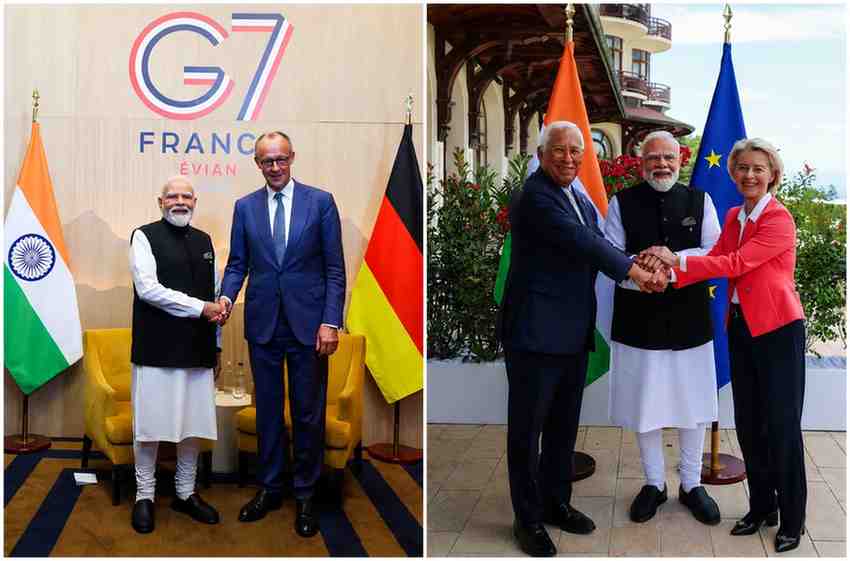
EVIAN, FRANCE: Prime Minister Narendra Modi intensified India’s diplomatic outreach in Europe during the G7 Summit by holding a trilateral meeting with European Council President António Costa and European Commission President Ursula von der Leyen, alongside a separate bilateral meeting with German Chancellor Friedrich Merz. The discussions focused on trade, technology, strategic autonomy, clean energy and strengthening long-term partnerships between India and Europe.
The engagements showcased India’s growing importance in Europe’s geopolitical and economic calculations at a time when global supply chains, energy security and technological leadership have become major international priorities.
India-EU Trilateral Meeting Signals A New Strategic Partnership
One of the key highlights of Modi’s visit was the trilateral meeting involving India’s Prime Minister, European Council President António Costa and European Commission President Ursula von der Leyen.
The leaders reaffirmed their commitment to elevating the India-European Union strategic partnership and accelerating cooperation across multiple sectors.
The discussions focused on creating resilient economies capable of navigating global uncertainties while promoting sustainable development.
Key areas discussed during the trilateral meeting:
- Advancing India-EU Free Trade Agreement negotiations
- Strengthening cooperation in artificial intelligence and digital technologies
- Enhancing clean energy partnerships
- Building resilient and diversified supply chains
- Cooperation on critical minerals and semiconductors
- Expanding connectivity and infrastructure initiatives
The meeting reflected a shared understanding that India and Europe can become indispensable partners in shaping future global economic and technological ecosystems.
Germany Emerges As A Key Strategic Partner
Prime Minister Modi also held bilateral talks with German Chancellor Friedrich Merz, reinforcing the long-standing India-Germany partnership.
Germany remains India’s largest trading partner in Europe and one of the country’s biggest sources of investment and advanced technology collaboration.
Both leaders discussed expanding cooperation in several priority sectors.
Major discussion points included:
- Increasing bilateral trade and investments
- Expanding defence and security cooperation
- Strengthening green energy collaboration
- Promoting innovation and advanced manufacturing
- Supporting skill development and mobility partnerships
- Deepening cultural and people-to-people exchanges
The leaders acknowledged the immense opportunities available for both countries as India continues its economic expansion and Germany seeks reliable international partners.
Why Europe Is Increasingly Looking Towards India
The meetings took place amid significant shifts in global geopolitics.
European nations are actively diversifying economic partnerships and reducing overdependence on limited supply chains.
India’s position as the world’s fastest-growing major economy, a technology hub and a trusted democratic partner makes it an attractive destination for long-term cooperation.
For Europe, India offers:
- A massive consumer market
- A growing manufacturing ecosystem
- Skilled human resources
- Expanding digital infrastructure
- Stable democratic institutions
At the same time, India stands to benefit from European investments, advanced technologies and expertise in green transitions.
India’s Diplomacy Goes Beyond Symbolism
The back-to-back meetings at the G7 Summit demonstrate how India’s diplomacy is increasingly becoming issue-based rather than alliance-based.
Instead of joining formal blocs, New Delhi is building strategic partnerships tailored to national interests and global priorities.
This approach allows India to collaborate with multiple partners simultaneously while preserving its strategic autonomy.
India’s diplomatic priorities are now centred around:
- Economic growth
- Technology partnerships
- Energy security
- Defence cooperation
- Supply chain resilience
- Sustainable development
A Message To The World
Although India is not a member of the G7, Prime Minister Modi’s presence and extensive bilateral engagements once again highlighted New Delhi’s growing influence on the global stage.
The meetings with Germany and the European Union leadership indicate that India is no longer viewed merely as a regional power but as an essential stakeholder in addressing global challenges.
As geopolitical competition intensifies and economic alliances evolve, India’s partnerships with Europe could become one of the defining strategic relationships of the coming decade.
The G7 summit engagements in Evian ultimately reinforce a larger reality: India is steadily positioning itself at the centre of global diplomacy, connecting the priorities of the Global South with the ambitions of advanced economies.