
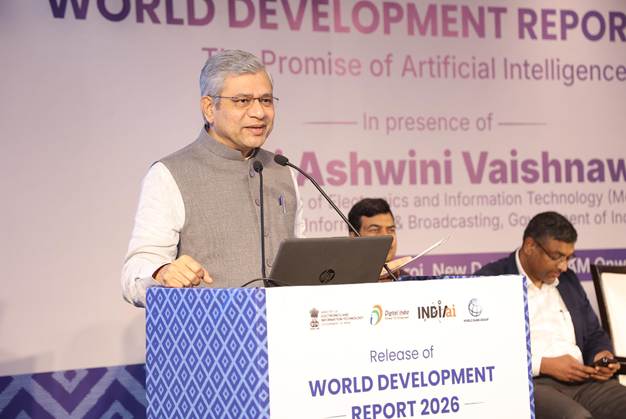
Union Minister Ashwini Vaishnaw on Thursday launched the World Bank Group’s World Development Report 2026: The Promise of Artificial Intelligence at an event in New Delhi, highlighting India’s growing role in using AI for inclusive development. The report examines how artificial intelligence can transform agriculture, healthcare, education and public services while improving productivity and access to expertise. It also underlines the importance of reliable digital infrastructure, quality data, computing capacity, skilled professionals and strong institutions to ensure that AI delivers sustainable and broad-based benefits across developing economies.
The report examines the opportunities AI can create for developing economies while highlighting the infrastructure, skills, institutions and policy frameworks required to use the technology safely and effectively.
The launch was organised by the IndiaAI Mission under the Ministry of Electronics and Information Technology (MeitY) in partnership with the World Bank Group. Senior policymakers, technology leaders, development experts and practitioners attended the event, which also featured a showcase of AI applications being implemented by Indian states.
AI Delivers Measurable Gains in Agriculture and Healthcare
Speaking at the event, Ashwini Vaishnaw highlighted India’s efforts to make AI accessible to ordinary citizens rather than limiting its benefits to technology-intensive sectors.
He cited an AI-based agricultural initiative in Baramati, Maharashtra, where sugarcane farmers reportedly achieved a 40 per cent increase in yields while using 30 per cent less water and fertiliser. The initiative combines satellite imagery, Internet of Things (IoT) and weather information to provide agricultural guidance.
Importantly, farmers can access the technology through voice services on mobile phones, allowing even those without computer experience to benefit from AI-enabled advice.
Ashwini Vaishnaw also pointed to the application of AI in healthcare, noting a 35 per cent increase in TB detection. He said such applications demonstrate how AI can extend specialised expertise to communities that may otherwise have limited access to advanced services.
In Gujarat, Ashwini Vaishnaw highlighted the use of AgriStack by around five lakh farmers and AI-based animal-health services benefiting millions of cattle and their owners.
World Bank Report Outlines AI Roadmap for Developing Economies
The World Development Report 2026 examines how developing nations can use AI to address longstanding challenges while avoiding unnecessary costs and technological risks.
The report emphasises three broad stages: adoption, adaptation and advancement. Rather than immediately attempting to develop expensive frontier AI systems, developing countries can adapt existing technologies to their own languages, institutions, markets and social requirements.
The report also stresses that successful AI deployment depends on fundamental infrastructure. Reliable electricity, digital connectivity, computing capacity, high-quality data, education, technical skills and effective institutions are critical to ensuring that AI translates into genuine development gains.
IndiaAI Mission Strengthens National AI Ecosystem
India is pursuing a comprehensive AI strategy through the IndiaAI Mission, which operates across seven key pillars.
These include IndiaAI Compute Capacity, the IndiaAI Innovation Centre for indigenous foundation models, the IndiaAI Datasets Platform or AIKosh, the IndiaAI Application Development Initiative, IndiaAI FutureSkills, IndiaAI Startup Financing and Safe & Trusted AI.
The programme seeks to expand access to computing resources, datasets and AI models while encouraging home-grown innovation.
The government is also focusing on applications tailored to India’s multilingual, diverse and large-scale environment. AI is being explored across agriculture, healthcare, education, governance, financial services and other areas with significant public impact.
Under the Safe & Trusted AI pillar, initiatives include work on AI bias mitigation, algorithm auditing, explainable AI, privacy-preserving technologies and deepfake detection.
World Bank Chief Economist Highlights India’s Global AI Lessons
Dr Michael Kremer, Chief Economist and Senior Vice President of the World Bank Group, said India’s experience could offer important lessons to other developing countries.

During his keynote lecture, “From AI Pilots to Scale: The Promise of AI in India,” Kremer emphasised that scaling AI requires more than sophisticated software. Human expertise, institutions, implementation systems and public infrastructure must work together.
He cited India’s AI-enabled weather forecasting initiatives as an example. Multiple AI models and meteorological information have been used to provide farmers with weather forecasts and agricultural advisories through text, voice and AI-powered systems.
Kremer noted that government involvement can be particularly important when technologies have substantial social benefits but limited immediate commercial incentives.
Ashwini Vaishnaw has similarly emphasised the importance of making AI accessible beyond technology-intensive sectors, particularly where digital tools can directly improve livelihoods and public services.
Experts Call for Moving Beyond AI Pilot Projects
Dr Gaurav Nayyar, Director of the World Development Report 2026, said India was already moving towards AI-driven development by adapting technologies to local circumstances.
He emphasised that governments in developing economies can simultaneously act as AI enablers, users and regulators.
The report encourages countries to remain optimistic, strategic and pragmatic in their AI policies. It argues that adapting proven technologies to local needs can often be more practical than attempting to build advanced systems independently at enormous cost.
Experts at the event also discussed the potential impact of AI on employment, noting that developing countries may have significant opportunities to use AI to increase productivity and expand access to services.
State AI Showcase Highlights India’s Grassroots AI Innovation
A State AI Showcase provided examples of how governments and innovators are applying AI to specific development challenges.
Andhra Pradesh presented Navachetana, an AI-enabled initiative designed to identify developmental delays among children between zero and six years of age.
Maharashtra showcased MahaVISTAAR AI, a platform designed to provide personalised agricultural advisories, digital services and farmer engagement.
Meghalaya presented EdskGrid, a GeoAI-based governance and intelligence platform focused on education.
Also Read | GST Council Scraps Tax Officers’ Arrest Powers, Raises Prosecution Limit To ₹5 Crore
Another featured innovation was Vyuhaa-Cerviai, a point-of-care cervical cancer screening solution developed by Vyuhaa Med Data.
India Focuses on Responsible and Inclusive AI Growth
The discussions highlighted the need to move successful AI projects from isolated pilot programmes to evidence-based solutions that can operate at scale.
Participants stressed the importance of better access to data and computing infrastructure, stronger institutional capacity and solutions designed around India’s diverse social and economic conditions.
The launch of the World Development Report 2026 places India’s AI ambitions within a broader global development debate. With examples ranging from 40 per cent higher agricultural yields to improved disease detection, the event highlighted the potential of AI to address practical challenges when technology is combined with appropriate institutions, infrastructure and human capabilities.
The broader message emerging from the discussions was that the future of AI-driven development will depend not only on creating advanced technology, but also on making it accessible, responsible, affordable and relevant to the people who need it most. Ashwini Vaishnaw stressed that such an approach can help ensure that AI becomes a practical instrument for development across India and the wider Global South.
Ashwini Vaishnaw also used examples from agriculture and healthcare to underline how AI applications can deliver measurable outcomes when they are adapted to local needs.
The event further reinforced the development-focused approach associated with Ashwini Vaishnaw, placing accessibility, responsible innovation and real-world applications at the centre of India’s AI ambitions.
Click here to join our WhatsApp Channel for real-time news updates and exclusive coverage.