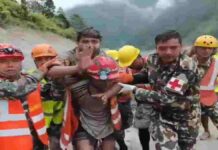
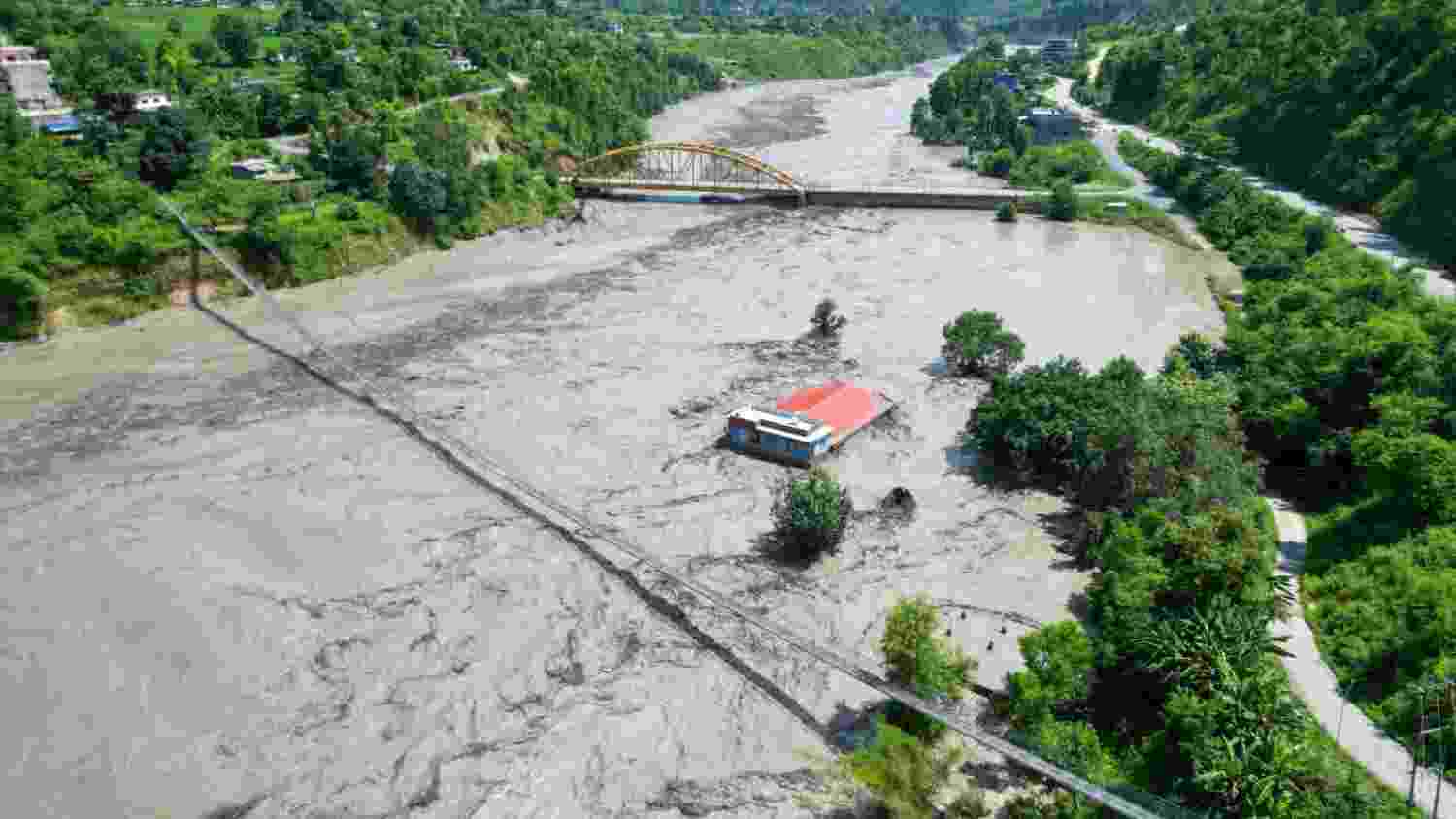
Nepal’s devastating flash floods have entered a critical phase, with the death toll climbing to 903 and thousands of people still missing as rescue teams intensify operations across some of the country’s worst-hit Himalayan regions.
The disaster, which struck on August 26 along the Nepal-Tibet border, unleashed enormous volumes of water, mud, rocks and debris across the Bhotekoshi and Trishuli river corridors. The destruction has wiped out homes, roads, bridges and vital infrastructure, while leaving rescue teams struggling to reach isolated communities.
According to the latest information from Nepalese authorities, 4,247 people remain missing in Nepal, while China has reported 16 deaths and 546 missing people in Tibet’s Gyirong County. Together, the disaster has left more than 4,800 people unaccounted for across the border region.
Ice-rock avalanche identified as likely trigger
Preliminary findings by Nepalese scientists indicate that the disaster may not have been caused by conventional monsoon rainfall alone.
A report commissioned by the Nepal Environment Society has identified a massive ice-rock avalanche in the high Himalayas as the likely trigger. The avalanche is believed to have generated a sudden and extremely powerful surge through the Bhotekoshi-Trishuli corridor.
The event struck with little warning, giving many residents almost no time to escape. Nepal’s disaster authorities have highlighted the lack of adequate high-altitude monitoring and cross-border weather data as a major challenge.
Officials said some communities received less than five minutes of warning before torrents of water and debris reached their homes.
More than 900 hydropower workers feared trapped
The rescue operation has become even more urgent after Nepal’s disaster management authorities reported that at least 933 workers could be trapped inside tunnels at around half a dozen hydropower projects.
Several hydropower facilities are located in areas devastated by the sudden flood surge. Mud, rocks and debris have blocked access routes and complicated efforts to determine how many people remain alive underground.
India, China and South Korea have sent specialist tunnel-rescue teams to assist Nepalese authorities. Rescue workers are attempting to clear blocked passages and reach workers who may still be sheltering inside the tunnels.
The search is being conducted under extremely difficult conditions, with damaged roads, unstable terrain and continuing flood threats slowing operations.
Fresh flood warnings raise fears of another disaster
Even as rescue teams search for survivors, authorities have warned of additional flooding.
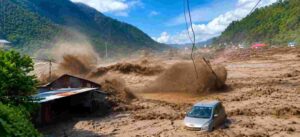
Water levels in the Bhotekoshi River have risen, prompting fresh alerts for communities in vulnerable areas. Nepalese authorities have also warned of a high risk of flash floods in Nuwakot and Rasuwa districts after China informed Nepal about increased upstream water flow.
The warning has complicated rescue operations, forcing teams to balance the urgency of reaching trapped people with the risk of sending personnel into potentially dangerous areas.
Nepal begins mass burial of unidentified victims
The scale of the tragedy has overwhelmed morgues and relief facilities.
Authorities have begun mass burials for some unidentified victims as bodies recovered from the disaster zone deteriorate rapidly. Families continue to gather at hospitals, rescue centres and other locations desperately searching for missing relatives.
India is sending forensic experts to Nepal to assist authorities with the identification of unidentified victims. The move is expected to help families establish the fate of relatives who remain missing.
The humanitarian situation is becoming increasingly complex as authorities attempt to manage both the large number of victims and the thousands of missing persons.
149 Indians rescued, hundreds remain under watch
India has been closely monitoring the situation because a large number of Indian nationals were in Nepal andar Tibet when the disaster struck.
Also Read — Tragedy Off Cyprus: Ferry With 267 Aboard Sinks, 7 Dead And 23 Missing
The Ministry of External Affairs has said that 149 Indians have been rescued in Nepal. In addition, 598 Indian nationals reportedly crossed safely from China into Nepal over two days, while around 900 Indians remain on the Chinese side but are said to be safe and in contact with authorities.
There is also concern over pilgrims from Tamil Nadu. A travel operator said 49 pilgrims from Tamil Nadu remain untraceable on the Chinese side after completing the Kailash pilgrimage.
The situation has prompted calls for greater coordination between Indian, Nepalese and Chinese authorities to establish the whereabouts and safety of those still missing.
India sends emergency relief supplies
India has stepped up humanitarian assistance to its neighbouring country.
More than 68 tonnes of emergency relief material have been sent to Nepal through four military flights, according to the latest updates. The supplies are aimed at supporting communities affected by the massive floods and helping ongoing relief operations.
The Indian response has included rescue assistance, relief supplies and support for identifying victims, highlighting the importance of regional cooperation during major disasters.
Families wait for answers as rescue continues
Across Nepal’s devastated communities, families remain trapped between hope and grief.
Survivors have returned to areas where homes once stood, finding buildings destroyed and streets buried beneath mud and rubble. In some places, entire settlements have been transformed by the force of the floodwaters.
Yet stories of survival continue to emerge. A 97-year-old woman, Guna Maya Bohara, was reportedly rescued alive after spending hours trapped beneath rubble at a care home, offering a rare moment of hope amid the widespread devastation.
With thousands still missing, rescue teams are continuing their search despite dangerous conditions. Nepal’s immediate priorities remain locating survivors, rescuing those trapped underground, recovering victims and delivering emergency assistance.
The disaster has also renewed concerns over climate change, glacier instability and the need for stronger early-warning systems across the Himalayan region. As Nepal confronts the enormous human cost of the floods, the coming days will be crucial in determining how many more survivors can be found and how quickly devastated communities can begin rebuilding.
Click here to join our WhatsApp Channel for real-time news updates and exclusive coverage.