
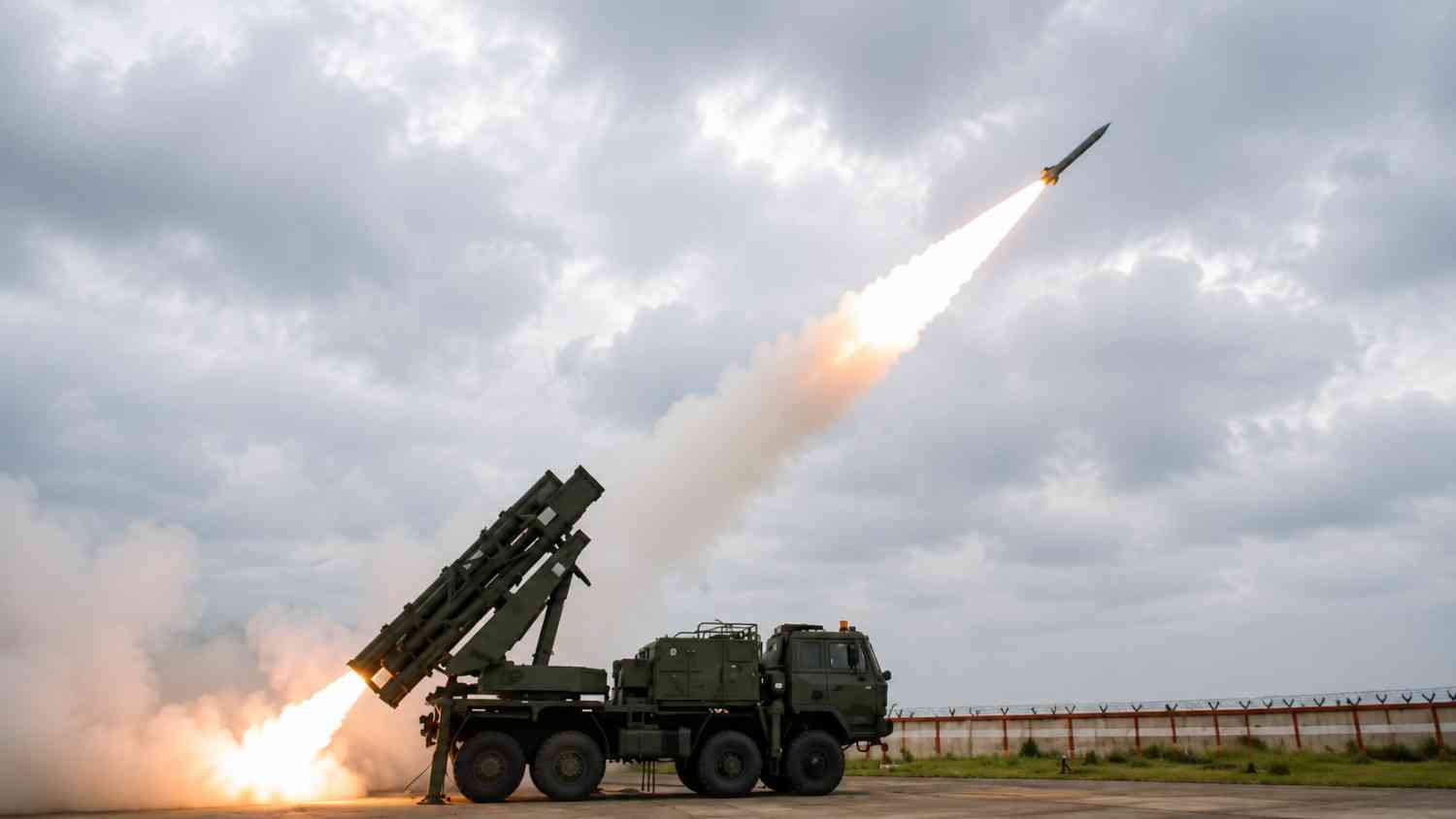
India has taken another significant step in strengthening its indigenous defence capabilities with the successful flight-test of the Pinaka Long-Range Guided Rocket (LRGR). The Defence Research and Development Organisation (DRDO) carried out the trial at the Integrated Test Range (ITR) in Chandipur, Odisha, on July 8, 2026. The test demonstrated the rocket’s ability to hit a designated target with exceptional precision while meeting all operational objectives.
Successful Trial Meets Operational Requirements
According to official information, the Pinaka LRGR was tested for a user-defined minimum operational range of 60 kilometres. The rocket successfully completed every planned phase of the mission, including all programmed in-flight manoeuvres, before striking the target with remarkable accuracy.
Officials stated that the rocket followed its predicted trajectory throughout the flight, validating both its navigation and guidance systems. The impact matched expectations precisely, highlighting the weapon system’s reliability and readiness for operational deployment.
Advanced tracking equipment positioned across the Integrated Test Range continuously monitored the rocket’s performance during the flight. The data collected from these instruments confirmed that the test met all planned mission parameters.
Indigenous Technology at the Core
The Pinaka Long-Range Guided Rocket has been developed entirely through India’s indigenous defence research ecosystem. The project was led by the Armament Research and Development Establishment (ARDE), working in close collaboration with the High Energy Materials Research Laboratory (HEMRL).

Additional technological support was provided by the Defence Research and Development Laboratory (DRDL) and the Research Centre Imarat (RCI), both of which contributed to key aspects of the rocket’s development.
The successful flight trial was coordinated by the Integrated Test Range along with the Proof & Experimental Establishment (PXE), ensuring that every phase of the launch and evaluation was conducted under stringent testing standards.
The achievement reflects the growing capability of India’s defence research institutions to design, develop and validate sophisticated guided weapon systems using domestic expertise.
Demonstrates Versatility of Existing Pinaka Launchers
One of the notable aspects of the latest trial was that the rocket was launched using the existing in-service Pinaka launcher. This demonstrated the launcher’s ability to fire different variants of the Pinaka rocket family without requiring major structural modifications.
Read Also: India’s Investor Focus Shifts To Governance As IPO Market Continues To Evolve
Such compatibility offers significant operational advantages for the Indian Army. It allows multiple rocket variants with varying engagement ranges to be deployed from the same launcher platform, reducing logistical complexity while improving battlefield flexibility.
The successful demonstration also supports future upgrades of the Pinaka weapon system, enabling the armed forces to integrate advanced guided rockets into existing infrastructure without extensive changes.
Precision Strike Capability Enhanced
The Pinaka rocket system has steadily evolved from an unguided multi-barrel rocket launcher into a family of increasingly sophisticated guided munitions. The Long-Range Guided Rocket further enhances India’s precision strike capability by combining extended range with high accuracy.
The latest successful test indicates that the system can engage targets at longer distances while maintaining precise targeting performance. Such capabilities are becoming increasingly important in modern military operations, where precision engagement helps improve mission effectiveness while reducing unintended damage.
The successful validation of the rocket’s guidance and control systems is expected to support future induction and operational deployment by the Indian Army.
Defence Leadership Applauds the Achievement
Raksha Mantri Rajnath Singh congratulated DRDO scientists, the Indian Army and industry partners involved in the successful flight-test.
He described the achievement as a major milestone in India’s indigenous defence technology journey and said it reflects the country’s growing capability to design and develop advanced long-range guided rocket systems domestically.
The Defence Minister noted that continued progress in indigenous weapon development contributes significantly to strengthening India’s self-reliance in defence manufacturing while enhancing national security.
DRDO Chairman Monitors the Trial
Defence Secretary and Secretary of the Department of Defence Research and Development, as well as DRDO Chairman, Rajesh Kumar Singh, closely monitored the trial.
Following the successful completion of the mission, he congratulated the scientists, engineers, technical staff and all teams associated with the programme for achieving another important milestone in India’s indigenous missile and rocket development efforts.
His appreciation extended to the various DRDO laboratories and testing establishments that collaborated throughout the design, development and validation process.
Boost to India’s Defence Modernisation
The successful test adds momentum to India’s broader efforts to modernise its armed forces with domestically developed weapon systems under the vision of self-reliance in defence production.
Over the past few years, DRDO has accelerated the development of advanced missiles, artillery systems, guided rockets and air defence technologies aimed at reducing dependence on imported military equipment.
The Pinaka Long-Range Guided Rocket programme represents an important component of this strategy, offering enhanced firepower, precision and operational flexibility for the Indian Army.
With another successful flight-test completed, the programme moves closer to strengthening India’s long-range artillery capabilities while showcasing the country’s expanding expertise in advanced defence technologies.
Click here to join our WhatsApp Channel for real-time news updates and exclusive coverage