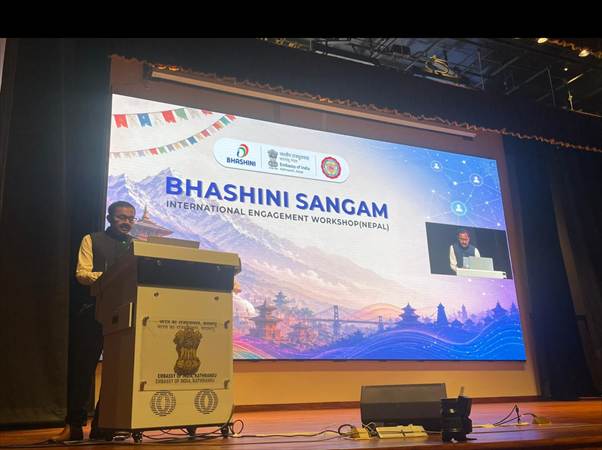
India and Nepal have taken a significant step towards strengthening cooperation in multilingual Artificial Intelligence (AI), with the Digital India BHASHINI Division organising an international workshop in Kathmandu focused on making digital services more accessible through local languages.
The BHASHINI Sangam: International Engagement Workshop (Nepal) was organised by the Digital India BHASHINI Division (DIBD), under the Digital India Corporation (DIC) and the Ministry of Electronics and Information Technology (MeitY), in partnership with the Embassy of India in Kathmandu and Kathmandu University.
The event brought together representatives from government, academia, research institutions, technology companies, startups, developers, students and language communities to explore how multilingual and voice-based AI can improve digital inclusion.
India-Nepal Partnership Gains Momentum in Language AI
The Kathmandu workshop builds on an existing Memorandum of Understanding between DIBD and Kathmandu University aimed at advancing cooperation in language technology and digital public infrastructure.
The discussions focused on expanding this partnership through joint development of technology, language datasets and practical applications designed around the linguistic requirements of communities in both India and Nepal.
The initiative comes at a time when AI-driven digital services are rapidly expanding, increasing the need for technologies capable of understanding and communicating in diverse languages.
Participants discussed opportunities to develop applications in Nepali, Maithili, Newari and other languages, with an emphasis on solutions that can address real-world needs.
BHASHINI Demonstrates Multilingual AI Capabilities
During the workshop, the BHASHINI team showcased several of its AI-powered capabilities through live demonstrations.
The demonstrations highlighted technologies including speech recognition, real-time language translation, voice-based interaction and document processing. These tools demonstrated how Language AI can make digital platforms easier to access, particularly for people who prefer communicating in their native or familiar languages.
The focus was not simply on translating existing digital content. The broader objective was to make technology more naturally responsive to different linguistic communities while reducing language-related barriers to digital services.
BhashaDaan Puts Community at Centre of AI Development
A dedicated BhashaDaan session underlined the importance of community participation and high-quality language data in developing representative AI systems.
Participants explored ways of contributing language resources across speech, text and image formats. Such datasets can play an important role in improving the ability of AI systems to understand languages, accents, expressions and culturally relevant forms of communication.
The session also highlighted the importance of ensuring that local communities have a role in shaping technologies that are eventually designed to serve them.
BHASHINI Sangam Promotes Cross-Border Language Innovation
BHASHINI Sangam is designed as an international engagement platform connecting governments, universities, researchers, developers, startups, language experts and communities.
Its larger objective is to encourage countries and communities to jointly create Language AI solutions by combining technological capabilities with local linguistic and cultural knowledge.
The initiative also places emphasis on preserving languages and cultural identities in the digital era. As AI becomes increasingly embedded in everyday services, ensuring that diverse languages and their associated knowledge are represented in emerging technologies is becoming an important part of digital inclusion.
The Kathmandu engagement seeks to transform India’s and Nepal’s shared linguistic and cultural connections into opportunities for innovation and technological collaboration.
Focus on Nepali and Other Local Languages
The workshop also examined potential applications of Language AI specifically for communities in Nepal and India.
By bringing together BHASHINI’s technology ecosystem with Kathmandu University’s academic and research expertise, participants explored possibilities for developing locally relevant applications.
The approach could support future solutions across areas where language accessibility is critical, including digital public services, education, information access and citizen-focused platforms.
Shri Suman Shekhar, First Secretary at the Embassy of India in Kathmandu, said the MoU between DIBD and Kathmandu University offers a strong foundation for expanding cooperation.
He highlighted the potential to create applications in Nepali, Maithili and other languages that could deliver practical benefits to people across the two countries.
‘Build With Languages,’ Says BHASHINI CEO
Shri Amitabh Nag, CEO of the Digital India BHASHINI Division, said India’s relationship with Nepal provides a distinctive opportunity to jointly develop Language AI.
He stressed that the objective goes beyond teaching AI systems to recognise languages such as Nepali, Newari and Maithili. Instead, the effort aims to develop technologies alongside the languages and the communities that use them.
The workshop enabled researchers, students, language specialists, developers, startups and ecosystem partners to exchange ideas on language datasets, research and practical AI applications.
India’s Growing Multilingual AI Ecosystem
The Digital India BHASHINI Division is India’s national platform for AI-powered multilingual digital inclusion. According to the organisation, its ecosystem supports 36 Indian text languages, 23 Indian voice languages and 35 international languages.
BHASHINI also supports more than 800 government websites and has enabled over 9 billion cumulative AI inferences, while processing more than 24 million AI inferences every day.
The platform is aimed at making Digital Public Infrastructure more accessible by enabling people to interact with technology through multiple languages and voice-based interfaces.
The Kathmandu workshop therefore represents more than a technology exchange. It signals an effort by India and Nepal to build a shared Language AI ecosystem in which governments, researchers, technology developers and communities can collaborate.
As digital transformation accelerates across the region, the India-Nepal partnership could help demonstrate how multilingual AI can turn language diversity into a bridge for greater digital participation, innovation and inclusion.
Click here to join our WhatsApp Channel for real-time news updates and exclusive coverage.