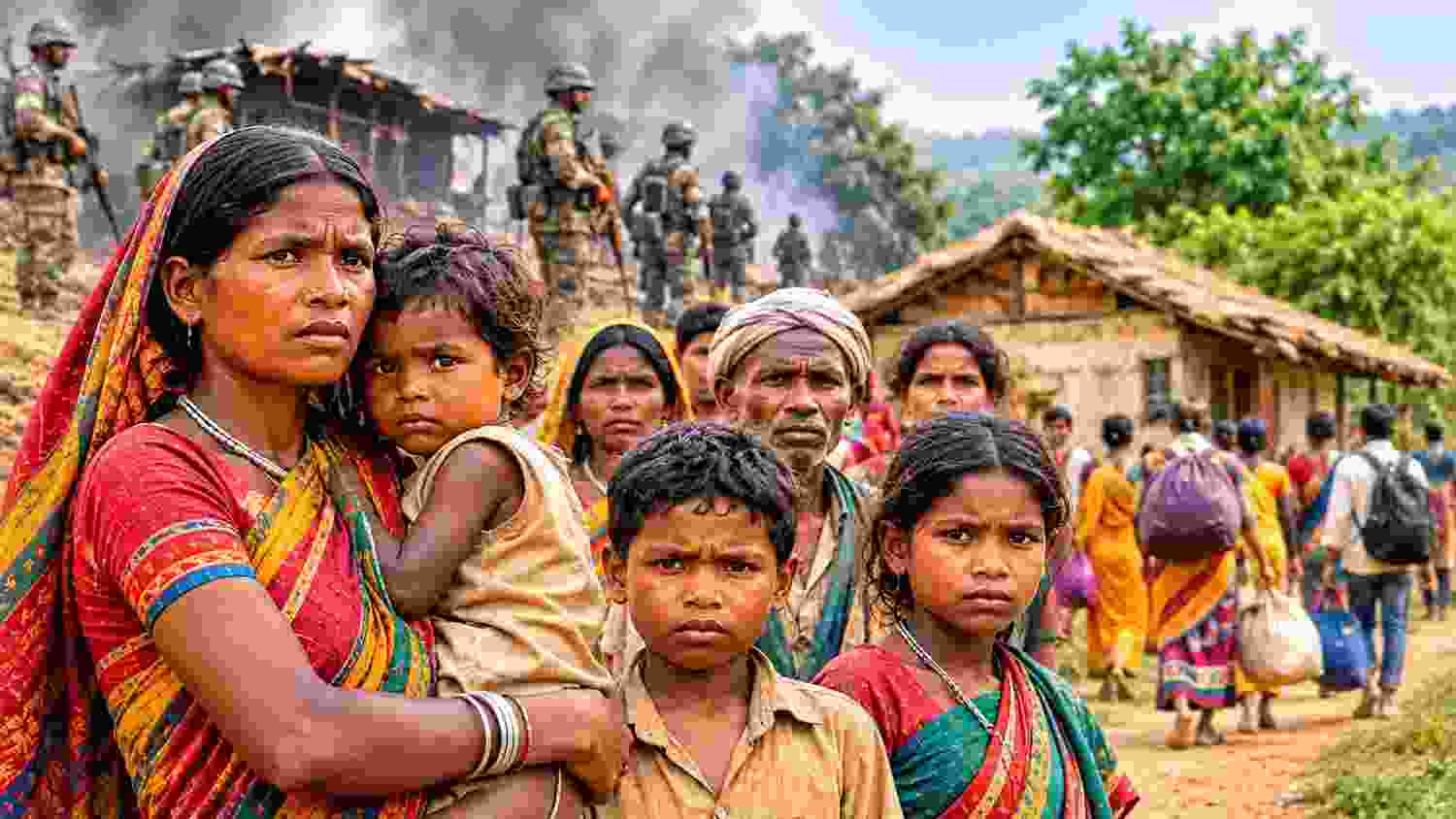
The Guthikoya tribal community remains among the most neglected victims of decades of Naxal violence and the Salwa Judum conflict in Chhattisgarh. Despite India’s declaration of being Naxal-free, thousands of displaced tribal families living in Telangana and Andhra Pradesh continue to face challenges involving identity, land rights, education, healthcare and basic government support. Their long struggle for dignity and rehabilitation raises an urgent question: will the end of Naxalism also mark the beginning of justice for the Guthikoya people?
Naxalism Ends, But the Plight of Displaced Tribal Families Remains
In March 2026, the Union Home Minister declared the country free from Naxalism. Prime Minister Shri Narendra Modi spent Deepavali 2026 in Bastar with the soldiers and jawans who fought the Naxals. The insurgency had held Dantewada and Bastar decades behind, and even the benefits of the “double-engine” government could not reach them properly. As that chapter closes, one question remains: who paid the price, and have they been heard?
Salwa Judum, which began in 2005, was a Chhattisgarh government initiative that armed local tribal youth, appointed as Special Police Officers (SPOs), to work with State and Central forces against the Naxals. In the Nandini Sundar case in 2011, the Supreme Court declared it unconstitutional and directed the State to stop using SPOs in anti-Naxal operations.
After the order, the SPOs no longer received State support, and armed Naxals attacked them brutally in retaliation. Villages in Bijapur, Sukma and Dantewada were already caught between the Maoists and the Salwa Judum. Many families crossed into the neighbouring States of the Dandakaranya region, and a large population ran to Andhra Pradesh and what is now Telangana.
Guthikoya IDPs: 50,000–60,000 Displaced Tribals Struggle for Identity
These families are known as Guthikoya internally displaced persons (IDPs). Most are Muria Gonds, with a smaller number of Dorla, both Scheduled Tribes in Chhattisgarh. In Telangana and Andhra Pradesh they came to be called Gothi Koya, “Gothi” meaning hill or high ground, and the Koya are a notified Scheduled Tribe in both States.
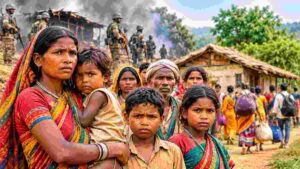
The Guthikoya are on no Scheduled Tribe list. No government has an exact count, but NGO estimates put the population at 50,000 to 60,000 in about 300 hamlets.
The best evidence is a study titled “Understanding the Status of Gotthi Koya IDP Children for Promotion of Child Welfare in Telangana”, authored by Prof. Bharath Bhushan Mamidi. It was conducted by the Centre for Economic and Social Studies (CESS), Hyderabad, in association with Bal Raksha Bharat, globally known as “Save the Children”.
CESS began as an autonomous research centre in 1980. In 1986 the Indian Council of Social Science Research (ICSSR), under the Ministry of Education, recognised it as a national institute, making it a state and ICSSR organisation. The report is dated July 2023. This three-year-old report has now been released at the request of the National Commission for Scheduled Tribes (NCST).
The study calls itself “the first comprehensive study of the status of Gotthi Koya IDPs from Chhattisgarh”. It covered 3,250 households in 121 settlements across 17 mandals of Jayashankar Bhupalapally, Mulugu and Bhadradri Kothagudem districts. About 94 per cent came from Chhattisgarh, mainly Sukma, Bijapur and Dantewada, and migration continued “even after the ban on Salwa Judum in 2011”.
CESS Report Highlights Education, Healthcare and Land Rights Crisis
Only 6 per cent of the population holds a caste certificate, and where one exists it reads “ST – 17 Koya”, the entry recognised in Telangana and Andhra Pradesh, not Gotthi Koya. Birth certificates are almost absent: “Zero percent of persons beyond 31 years possess Birth Certificates.”
Also Read | Nestoria Group Accelerates Real Estate Growth With 10X Business Training Initiative In Delhi
Less than 1 per cent receive any pension. About 71 per cent of eligible persons hold voter cards, yet “they are not eligible to contest elections as tribal representatives”. On land, the report is direct: “The Gotthi Koyas do not have any pattas (land titles) or protection from eviction.”
About 59 per cent of the population is illiterate. More than a quarter of children aged 6 to 18 had never enrolled in school, and only 3 per cent of students studied beyond high school. Over 75 per cent of deliveries took place at home, only 12 per cent of them assisted by a trained birth attendant. The study reports 90 infant deaths and 31 child deaths in five years.
Cases filed by forest officials or the police have affected almost all the IDPs. Branded as “police informers” or sympathisers of extremists, many adults must report to the nearest police station every week, and the report says this attendance is used to make them do forced labour.
The Forest Rights Act, 2006 gave titles to local tribal communities in the erstwhile Andhra Pradesh from 2008. The Guthikoya were left out. They are not notified Scheduled Tribes, and having been displaced on or after 1980, they do not fit the definition of “other traditional forest dweller” in section 2 of the Act. In government records, these settlements do not exist.
Guthikoya IDP Accord: Rehabilitation on the Bru Model
The Centre has settled a comparable problem before. The Reang (Bru) tribals were driven out of Mizoram and spent more than two decades in relief camps in Tripura. In January 2020, the Union Government, the governments of Tripura and Mizoram and Bru representatives signed an agreement that settled them permanently in Tripura.
That settlement involved the Union and two States. The Guthikoya case involves three: Andhra Pradesh & Telangana put together an estimated 50,000- 55,000 IDP’s , and Chhattisgarh, the State they left.
Chhattisgarh may now be ready to receive them back, but a full generation has grown up in Telugu-speaking States. The children studied in Telugu and many adults found local work. Many families may not want to return. Rehabilitation therefore has to be offered at both ends, in Andhra Pradesh and Telangana for those who stay and in Chhattisgarh for those who go back.
Now that the country has been declared Naxal-free, it is high time to focus on the welfare and rehabilitation of the Guthikoya IDPs. The victims of Salwa Judum and the Maoist conflict cannot be left outside the story of peace. The Central Government may consider an accord similar to the one reached for the Reang (Bru) tribal IDPs who were displaced from Mizoram to Tripura.
A Guthikoya IDP Accord should be formulated involving Andhra Pradesh, Telangana, Chhattisgarh and the Union of India, with the initiative led by the Ministry of Home Affairs. The CESS report has supplied the facts. What remains is the decision to act on them.
Click here to join our WhatsApp Channel for real-time news updates and exclusive coverage.