

Q6. Can India use its diplomatic relationships with countries in the Gulf, Europe, Russia and other regions to create stronger international guarantees for the safety of Indian seafarers?
Answer: Yes. India can—and actively does—leverage its unique “multi-aligned” diplomatic partnerships across the Gulf, Europe, Russia, and major flag-state nations to construct stronger international guarantees for its seafarers.
Because global shipping separates vessel ownership, flag registration, and crew nationality, no single nation can guarantee maritime safety alone. India’s strategic value across diverse geopolitical blocs allows it to build institutional, legal, and operational protections across four primary diplomatic channels:
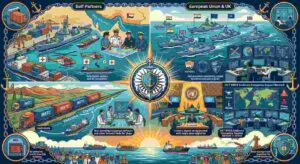
Gulf Partners: On-the-Ground De-escalation & Port Security
- Strategic Leverage: India maintains deep security, trade, and diaspora linkages with the Gulf Cooperation Council (GCC) nations (UAE, Saudi Arabia, Oman, Qatar) as well as working diplomatic channels with Iran.
- Practical Protection:
- Safe-Haven Access & Port Privileges: Diplomatic agreements with Oman (Duqm Port) and the UAE allow Indian naval ships and merchant vessels rapid emergency docking, refuelling, and medical evacuation rights during regional escalations in the Persian Gulf or Strait of Hormuz.
- Conflict De-confliction: India uses its unique diplomatic access to Tehran and regional actors to advocate directly for the non-targeting of merchant vessels carrying Indian crews, facilitating prompt consular access and crew release when vessels are detained.
European Union & UK: Escort Coordination & Legal Norms
- Strategic Leverage: Europe is heavily reliant on secure sea lines of communication (SLOCs) for trade and energy transit, making merchant crew safety a shared economic interest.
- Practical Protection:
- Operational Interoperability: The Indian Navy coordinates closely with European naval initiatives—such as EUNAVFOR Operation ASPIDES (Red Sea protection) and Operation ATALANTA (Horn of Africa)—to synchronize patrol grids, share intelligence via the IFC-IOR, and execute joint search-and-rescue (SAR) missions.
- Standardized High-Risk Clauses: India works with European maritime regulators and shipping federations to enforce strict compliance with the Maritime Labour Convention (MLC, 2006), ensuring Indian mariners serving on European-owned ships retain the legal right to decline transit through designated war zones without facing contract termination.
Russia: Black Sea Logistics & Eurasian Security
- Strategic Leverage: India’s historic strategic partnership with Moscow gives New Delhi direct lines of communication to discuss maritime security in the Black Sea and the Azov Sea.
- Practical Protection:
- Humanitarian Corridors: During heightening Black Sea shipping risks, Indian diplomacy relies on high-level contacts in Moscow to secure safe-transit maritime corridors for merchant ships carrying Indian crew members.
- Alternative Maritime Routes: India and Russia collaborate on developing secure, alternative trade corridors—such as the International North-South Transport Corridor (INSTC) and the Eastern Maritime Corridor (Vladivostok to Chennai)—which reduce dependence on volatile western chokepoints.
Major Flag States (Liberia, Panama, Marshall Islands): Bridging the Flag-State Gap
- Strategic Leverage: Most Indian seafarers work on ships registered under “flags of convenience” (e.g., Liberia, Panama, Marshall Islands), where flag states hold primary legal jurisdiction under UNCLOS.
- Practical Protection:
- Co-Founding UN Coalitions: India and Liberia launched the Group of Friends on Safety and Security of Shipping and Seafarers (GoF on S4) at the UN. This coalition bridges flag-state authority with labour-supplying nations to demand international accountability, strict war-risk insurance, and universal non-combatant protections for civilian crews.
- Maritime Bilateral: India is negotiating direct bilateral pacts with open registries (Panama, Liberia) to mandate real-time crew reporting to the Indian Directorate General of Shipping whenever a ship enters an active conflict zone.
By combining Gulf logistics, European naval coordination, Russian conflict communication, and flag-state legal alliances, India turns its multi-aligned diplomacy into a tangible defense shield for its 310,000+ seafarers.
Q7. With India holding the BRICS Chairship in 2026, can BRICS evolve from political dialogue into a practical maritime-security platform for protecting seafarers and global shipping?
Answer: India is leveraging its 2026 BRICS Chairship in New Delhi to shift the bloc from general geopolitical declarations toward concrete, actionable maritime-security mechanisms. At the 18th BRICS Summit in New Delhi, Prime Minister Narendra Modi proposed establishing a BRICS Seafarers’ Emergency Support Network. This initiative addresses the vulnerabilities highlighted by ongoing conflicts in West Asia, the Strait of Hormuz, and the Black Sea—regions where commercial shipping and civilian mariners regularly face missile attacks, vessel seizures, and stranding.
How BRICS Is Evolving into a Practical Maritime Platform
The Seafarers’ Emergency Support Network
India’s proposal creates a coordinated, multi-nation framework designed to streamline real-time crisis response:
- Cross-Border Intelligence & Distress Relays: Direct operational links connecting maritime authorities, port registries, and diplomatic missions across BRICS member states to rapidly log distress alerts.
- Joint Medical Aid & Evacuation: A shared protocol for emergency medical evacuations, hospitalizations, and repatriation of crew members trapped in conflict waters.
- Consular & Legal Coordination: Standardized procedures to assist seafarers on vessels registered under foreign “flags of convenience”, bridging the legal gap between crew nationality and ship registration.
BRICS Logistics Framework & Supply-Chain Security
Alongside crew safety, India introduced the BRICS Logistics Framework, which directly intersects with maritime trade security:
- Synchronizing technical exchange and knowledge-sharing for cargo and shipping services across major BRICS ports (e.g., Chennai, Santos, Shanghai, Durban, Bandar Abbas).
- Creating resilient maritime transport links less vulnerable to unilateral sanctions or sudden chokepoint blockades.
Intelligence Sharing via Maritime Domain Awareness (MDA)
BRICS member states sit along crucial global sea lanes—from the Malacca Strait and Indian Ocean to the Cape of Good Hope, South Atlantic, and Persian Gulf.
- India is advocating for linking data networks—such as the Information Fusion Centre – Indian Ocean Region (IFC-IOR) in Gurugram—with maritime centres in Brazil, South Africa, Egypt, the UAE, and Iran.
- This enables real-time tracking of non-traditional maritime threats, piracy, and uncrewed aerial or surface vehicle (UAV/USV) activity in high-risk zones.
Key Challenges to Operationalizing BRICS Maritime Security
While India’s Chairship establishes the foundation, converting BRICS into a fully operational security platform faces structural hurdles:
- Divergent Strategic Interests: BRICS includes nations with differing naval doctrines and geopolitical alignments (e.g., China, Russia, Iran, UAE, India, Brazil). Establishing a unified naval command or joint patrol force under a BRICS flag remains unlikely.
- Non-Military vs. Military Focus: India intentionally frames this cooperation around humanitarian assistance, search-and-rescue (SAR), crew protection, and logistics rather than hard military alliances, ensuring broad consensus without creating a rigid security bloc.
- Flag State Compliance: Because most global merchant ships are flagged in non-BRICS open registries (Panama, Liberia, Marshall Islands), BRICS initiatives must coordinate closely with the International Maritime Organization (IMO) and international shipowner federations to enforce binding protections.
Through its 2026 Chairship, India is showing that BRICS does not need to become a military alliance to deliver tangible maritime security. By focusing on civilian seafarer protection, emergency humanitarian response, and logistics resilience, New Delhi is positioning BRICS to fill a vital gap in global maritime governance—turning political dialogue into a life-saving mechanism for merchant sailors on the high seas.
Q8. Could the proposed BRICS Seafarers Emergency Support Network eventually include a 24/7 distress-alert system connecting maritime authorities, embassies and shipping companies?
Answer: The operational core of India’s proposed BRICS Seafarers’ Emergency Support Network is designed to connect maritime authorities, diplomatic missions, and shipping entities in real time. A 24/7 distress-alert and response architecture is not just a future possibility—it represents the primary practical delivery mechanism for the proposal.
Centralized Real-Time Escalation
Currently, when a merchant vessel carrying a multi-national crew encounters an attack, drone strike, or seizure, distress calls go to the ship’s Flag State (often open registries like Panama or Liberia) or distant regional Maritime Rescue Coordination Centres (MRCCs).
- A 24/7 BRICS network links the Information Fusion Centre – Indian Ocean Region (IFC-IOR) in India with counterpart maritime control hubs across BRICS nations (such as Iran, UAE, Egypt, South Africa, and Brazil).
- When a Ship Security Alert System (SSAS) signal is triggered, alert data automatically broadcasts to the nearest BRICS coastal authority and relevant diplomatic missions simultaneously.
Bridging the Shipowner–Flag State Jurisdiction Gap
A major hurdle during maritime crises is identifying crew details quickly on foreign-flagged ships.
- By incorporating shipping companies, ship managers, and Manning/RPSL agencies directly into the portal, the alert system automatically pulls verified crew manifests, passport numbers, and next-of-kin contacts the moment a ship enters a designated High-Risk Area (HRA).
- This eliminates days of bureaucratic delay when requesting urgent consular intervention or medical evacuation.
Dual-Channel Response (Naval & Consular)
Once a distress alert is logged, the system splits action into two parallel tracks:
- Operational Track: Direct relay to patrolling naval assets (e.g., Indian Navy destroyers, EUNAVFOR, or regional coast guards) for immediate search-and-rescue (SAR) or anti-piracy intervention.
- Diplomatic & Humanitarian Track: Instant notification to relevant embassies near the nearest port of call to issue Emergency Certificates, coordinate hospital admissions, and arrange safe land transit.
Q9. How can India balance tighter maritime-security requirements with the need to keep Indian ports efficient, commercially competitive and attractive to international shipping?
Answer: Balancing stringent maritime security with high commercial efficiency requires shifting from traditional, physical gatekeeping to data-driven, non-intrusive, and risk-based security models.
Key Strategies to Harmonize Security and Commercial Competitiveness
Transition to Data-Driven and Non-Intrusive Security
- Non-Intrusive Inspection (NII) Technologies: Deploy high-throughput Drive-Through Container Scanners (DTCS) and advanced X-ray/Gamma scanners at container terminals. This allows customs and security personnel to inspect high-risk cargo without physically unsealing containers, keeping turnaround times low.
- Predictive Risk Management: Utilize AI and machine learning to analyze manifest data, vessel tracks, and trading histories prior to ship arrival. High-risk cargo gets flagged for targeted inspection, while verified low-risk shipments clear security automatically through green channels.
Digitalization and Single-Window Systems
- Integrated Port Community System (PCS): Standardize all administrative clearances, customs documentation, and security protocols under digital platforms.
- Automated Gate Systems (AGS): Replace manual gate checks with Optical Character Recognition (OCR), RFID tracking, and automated biometric access for truckers and port personnel, cutting gate-in and gate-out dwell times significantly.
Standardized Security Protocols (ISPS Compliance)
- Tiered Security Architecture: Ensure all major and non-major ports maintain strict compliance with the International Ship and Port Facility Security (ISPS) Code through unified, standardized procedures. Standardizing security workflows across all Indian maritime boards prevents port-hopping by bad actors and eliminates operational friction caused by varied regional regulations.
- Authorized Economic Operator (AEO) Programs: Expand trusted-trader frameworks so that accredited logistics players enjoy fast-track customs and security clearances, incentivizing self-compliance across the supply chain.
Integrated Domain Awareness & Inter-Agency Coordination
- Coastal Security & Maritime Domain Awareness: Enhance coordination between the Indian Navy, Indian Coast Guard, Customs, and Port Authorities via unified command structures (e.g., Information Fusion Centre – Indian Ocean Region). Sharing intelligence in real time prevents last-minute, security-driven vessel disruptions at berth.
- Cybersecurity Fortification: Protect port operating systems (TOS) and critical infrastructure from cyber threats through central guidelines monitored by CERT-In and the National Critical Information Infrastructure Protection Centre (NCIIPC), ensuring digital efficiency without vulnerability.
Strategic Development of Transshipment Infrastructure
- In-Country Transshipment Hubs: Developing mega transshipment hubs (such as Vizhinjam or Galathea Bay) keeps transshipment cargo within Indian legal and security jurisdictions. This reduces reliance on foreign transshipment ports, lowers freight turnaround times, and gives Indian security agencies full visibility over regional feeder networks.
Q10. Cyberattacks against ships, ports and navigation systems are becoming a growing concern. Should cyber-security training become mandatory for Indian seafarers and shipping companies?
Answer: Yes, cyber-security training should become mandatory for both Indian seafarers and shipping companies.
Modern vessels are essentially floating smart factories. Critical operational technology (OT)—such as GPS/GNSS navigation, Electronic Chart Display and Information Systems (ECDIS), dynamic positioning, and automated engine management—is increasingly networked alongside onboard IT systems. A cyber incident at sea is not just an IT inconvenience; it is a direct threat to life, property, environmental safety, and national maritime security.
Key Reasons Mandatory Cyber Training is Urgent for India
Human Error is the Primary Vulnerability
The vast majority of maritime cyber incidents stem from social engineering—phishing, rogue USB drives inserted into bridge computers, or weak credential hygiene. Because Indian seafarers form a massive share of the global maritime workforce, baseline cyber hygiene must become second nature to prevent accidental compromises on global and domestic fleets.
Also Read | BHASHINI and IISc Bengaluru Launch AI Speech Technology To Revive Sourashtra Language
OT Systems pose Physical, Real-World Risks
Unlike standard corporate IT attacks, cyber threats in shipping heavily target Operational Technology (OT). Cyber spoofing or ransomware targeting dynamic positioning or engine control units can cause groundings, collisions, or oil spills. Training must ensure crew members can spot OT anomalies and safely revert to manual override protocols.
Alignment with IMO and Global Mandates
The International Maritime Organization (IMO) mandates that cyber risk management be integrated into every vessel’s mandatory Safety Management System (SMS) under Resolution MSC.428(98) of June 2017. Mandatory training ensures Indian shipping companies and seafarers stay compliant with global port state controls (PSC) and international chartering standards.
For Seafarers (Individual Level)
• STCW Integration: The Directorate General of Shipping (DGS) should mandate a basic cyber-awareness module within the mandatory STCW (Standards of Training, Certification and Watchkeeping) foundational courses.
For Shipping Companies (Organizational Level)
• Mandatory Drills & Simulations: Companies should conduct regular onboard cyber-attack simulations (e.g., simulated ransomware or lost satellite comms) alongside traditional fire and abandon-ship drills.
• Dedicated Cyber Officers: Require shipping operators to designate trained shore-side and shipboard Cyber Security Officers responsible for OT updates, network segmentation, and incident escalation.
• Supply Chain Audits: Mandate vetting protocols for third-party technicians, contractors, and port engineers who connect external hardware to shipboard systems during port calls.
Making cyber training mandatory through DG Shipping would protect crew safety, safeguard India’s critical maritime supply chains, and reinforce India’s reputation as a high-quality, trusted maritime workforce provider globally.
Q11. What additional protection is required for Indian crews sailing through piracy-prone waters and strategically sensitive maritime chokepoints?
Answer: Protecting Indian seafarers in high-risk zones—such as the Bab-el-Mandeb Strait, Red Sea, Gulf of Aden, Strait of Hormuz, and Gulf of Guinea—requires a multi-layered defense model combining military escorting, technical vessel hardening, regulatory mandates, and financial safeguards.
Key Layers of Protection for Indian Crews
Naval Protection and Convoy Escorts
• Operation Sankalp & Convoy Escorts: The Indian Navy maintains continuous warship deployments (destroyers, frigates, and replenishment tankers) across sensitive maritime corridors to provide direct convoy escorts for merchant ships carrying Indian crews.
• Real-Time Tracking via IFC-IOR: Directorate General of Shipping (DGS) directives mandate that vessels transiting High-Risk Areas (HRAs) register and submit daily position logs to the Information Fusion Centre – Indian Ocean Region (IFC-IOR), ensuring immediate naval assistance during a crisis.
Physical Hardening and Anti-Piracy Countermeasures
Merchant operators employing Indian crews are required to strictly implement Best Management Practices (BMP) on board:
• Citadel Protection: Fortified, safe rooms equipped with independent radio communications, satellite phones, food, water, and engine control overrides.
• Physical Deterrents: Installation of razor wire, high-pressure water cannons, acoustic devices, and physical barriers along low-freeboard decks.
• Armed Guard Integration: Utilizing Privately Contracted Armed Security Personnel (PCASP) onboard commercial vessels to deter boarding attempts by armed pirates or hostile skiffs.
Countermeasures Against Asymmetric Threats (Drones and Missiles)
Given recent shifts from traditional Somali piracy to asymmetric warfare (unmanned aerial vehicles, anti-ship missiles, and sea-skimming drones in the Persian Gulf, Strait of Hormuz, Red Sea and Gulf of Aden):
• Electronic Countermeasures (ECM): Installation of GPS/GNSS anti-jamming and anti-spoofing navigation software on commercial vessels.
• Enhanced Lookouts and Radar Tracking: Continuous 24/7 visual and thermal watchkeeping to spot low-altitude drones or approaching uncrewed surface vessels (USVs).
• Pre-Voyage Evasive Routing: Utilizing naval intelligence to alter sea lanes dynamically, avoiding known threat pockets near volatile coasts.
Mandatory Pre-Deployment Training & Drills
• HRA-Specific Safety Briefings: Under DGS protocols, crews must undergo pre-transit training covering citadel entry protocols, blackout procedures, evasive manoeuvring, and emergency communication sequences.
• Anti-Hostage & Survival Training: Specialized STCW modules that prepare seafarers psychologically and operationally for hostage or high-risk maritime hijack scenarios.
Regulatory, Contractual, and Insurance Safeguards
• Right of Refusal: Under International Maritime Bargaining Council (IBF) and national seafarer agreements, seafarers have the legal right to refuse sailing into designated Warlike or High-Risk Areas without risking job loss or blacklisting.
• Double Wage Compensation & War-Risk Insurance: Crew members transiting designated conflict zones are entitled to double basic pay, elevated hazard bonuses, and mandatory war-risk insurance coverage paid by the vessel operator.
• 24/7 Family Support Centres: Manning agencies (RPSL) are mandated by DG Shipping to maintain continuous emergency desks to keep seafarers’ families informed during passage through volatile transit zones.
Click here to join our WhatsApp Channel for real-time news updates and exclusive coverage.
In an exclusive interview with Global Tribune Media Network (GTMN), our Editor-in-Chief Shree Dibakar Kundu, Dr. Madhumita Kothari, a Senior International Development Professional, Policy Advisor, and Supreme Court Advocate, shares her insights on maritime security, ocean governance, international law, and India’s strategic priorities.
With 30 years of multidisciplinary expertise, Dr. Madhumita Kothari specialises in the Blue Economy, ocean governance, and South–South and Triangular Cooperation. She holds a Ph.D. in Blue Economy and Ocean Governance, an LL.M. in Shipping Laws with distinction from the UK, an LL.B., an MBA in International Business, an M.A. in Geography, and a gold-medal postgraduate diploma in International Human Rights Laws.
As Former Senior Advisor to the United Nations International Seabed Authority, she advanced international institutional cooperation, marine scientific research, capacity building, and sustainable deep-seabed resource governance. An accomplished author and international keynote speaker, Dr. Kothari has received several honours, including the Bharat Gaurav Ratna Award for Excellence in Maritime Studies and the National Legal Luminary Award.

