In a major breakthrough for Indian language technology, the Digital India BHASHINI Division and the Indian Institute of Science (IISc), Bengaluru, have developed artificial intelligence-powered Text-to-Speech (TTS) models for Sourashtra, a minority Indo-Aryan language spoken predominantly by the Sourashtra community in Tamil Nadu. The initiative marks an important step towards bringing underrepresented Indian languages into the digital ecosystem through advanced speech technology.
The project, undertaken by the Digital India BHASHINI Division (DIBD), operating under the Digital India Corporation (DIC), Ministry of Electronics and Information Technology (MeitY), aims to improve digital accessibility, support language learning and expand the availability of AI-based solutions for languages with limited digital resources.
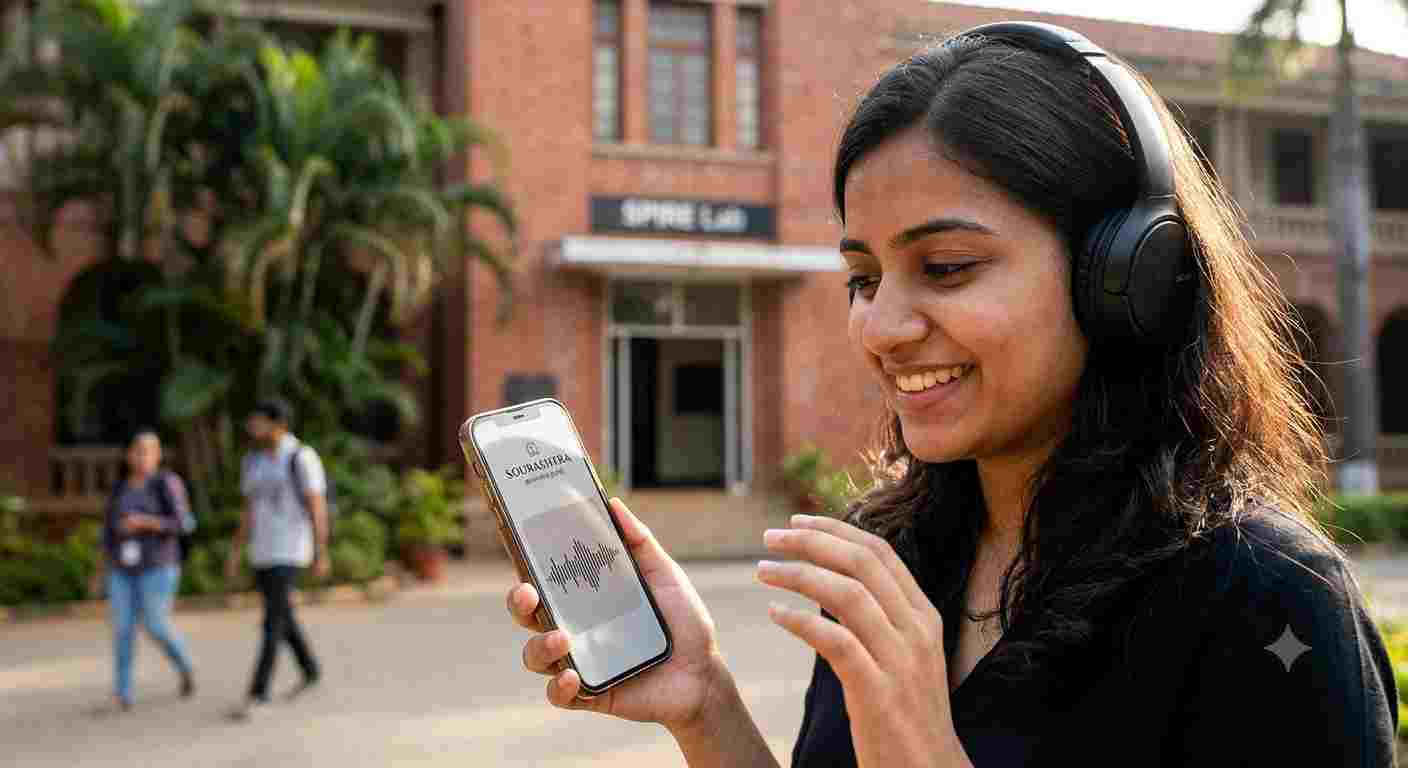
The newly developed technology can convert written Sourashtra text into spoken audio, allowing users to access digital content in their language. By making speech synthesis available in two scripts and through male and female voices, the initiative seeks to make Sourashtra more accessible across educational, research and public-facing digital applications.
Four AI Models Support Two Scripts and Multiple Voices
The Sourashtra Text-to-Speech system uses the VITS (Variational Inference with adversarial learning for end-to-end Text-to-Speech) architecture, an advanced approach that enables the generation of natural-sounding speech directly from text.
The development includes four models covering two voice options—male and female—with each available in both Tamil script and Sourashtra script. This arrangement allows the technology to accommodate different writing preferences within the language community.
The models have been trained using a dedicated speech corpus developed at the Speech Processing and Intelligent Research in Engineering (SPIRE) Lab at IISc Bengaluru. The dataset contains more than 28 hours of gender-balanced speech recordings featuring one male and one female voice artist.
The corpus incorporates carefully selected sentences, including composed material and passages drawn from literature. Text transcriptions are available in both Sourashtra and Tamil scripts, creating a valuable resource for further research and language technology development.
AIKOSH Makes Sourashtra Speech Data Available
A significant component of the initiative is the availability of the SPICOR TTS 3.0 Sourashtra Corpus on BHASHINI’s AIKOSH platform. AIKOSH provides access to datasets and resources intended to support the development of artificial intelligence technologies for Indian languages.
With more than 28 hours of speech data, the Sourashtra corpus offers researchers, developers and institutions an important foundation for building additional language applications. Its gender-balanced recordings and multilingual-script transcriptions can also support experimentation and further improvements in speech synthesis.
According to the project details, the male voice model was trained on approximately 10,000 utterances, while the female voice model used around 11,400 utterances. The speech recordings and associated text data underwent preparation and cleaning to support the training process.
The models generate audio at a sampling rate of 22,050 Hz and process character-level text directly, eliminating the need for a separate phonemizer. This technical approach is particularly relevant to languages for which established pronunciation-processing tools and extensive digital resources may not be readily available.
Sourashtra Language Gets a Stronger Digital Presence
Sourashtra is spoken by approximately 2.48 lakh people, according to the 2011 Census. Despite its cultural and linguistic significance, the language has comparatively limited representation in digital platforms and fewer dedicated speech technology resources.
Also Read | Rajnath Singh Slams Congress Over ‘Regime Change’ Plot Amid CEC Gyanesh Kumar Row
The new AI-based models could help address this gap by enabling written content to be converted into audio, making information more accessible to people who prefer listening rather than reading.
For students and language learners, the technology could support speech-enabled educational resources and help users become more familiar with written Sourashtra. It could also assist in developing digital tools for reading literature aloud, language documentation and research into low-resource speech synthesis.
Accessibility is another important area of potential impact. Speech-enabled applications can help users interact with digital information through audio, while developers may use the models as a foundation for new services tailored to Sourashtra-speaking communities.
The availability of the underlying corpus also creates opportunities for academic institutions and researchers to explore further applications, improve existing systems and develop additional resources for a language that has historically received limited attention in mainstream digital technology.
BHASHINI Advances AI-Powered Multilingual Inclusion
The collaboration between BHASHINI and IISc Bengaluru reflects a broader effort to use artificial intelligence to reduce language barriers in digital services. Developing technology for languages with limited datasets is an important part of ensuring that India’s linguistic diversity is represented in the country’s expanding digital infrastructure.
BHASHINI seeks to make digital information and public-facing services more accessible across languages through technologies such as machine translation, speech recognition, speech synthesis and transliteration.
About Digital India BHASHINI Division
The Digital India BHASHINI Division operates under the Digital India Corporation within the Ministry of Electronics and Information Technology. It is working to establish a national ecosystem for AI-powered multilingual digital inclusion.
Its stated language-support ecosystem covers 36 Indian text languages, 23 Indian voice languages and 35 international languages. By facilitating the integration of language AI capabilities into government and public-facing digital services, BHASHINI aims to make information and technology more accessible to people across India’s diverse linguistic communities.
The development of Sourashtra speech models adds another resource to this effort. By combining academic research, dedicated speech datasets and AI-powered synthesis, the initiative offers a promising pathway towards preserving linguistic heritage while expanding the practical use of underrepresented Indian languages in the digital age.
Click here to join our WhatsApp Channel for real-time news updates and exclusive coverage.