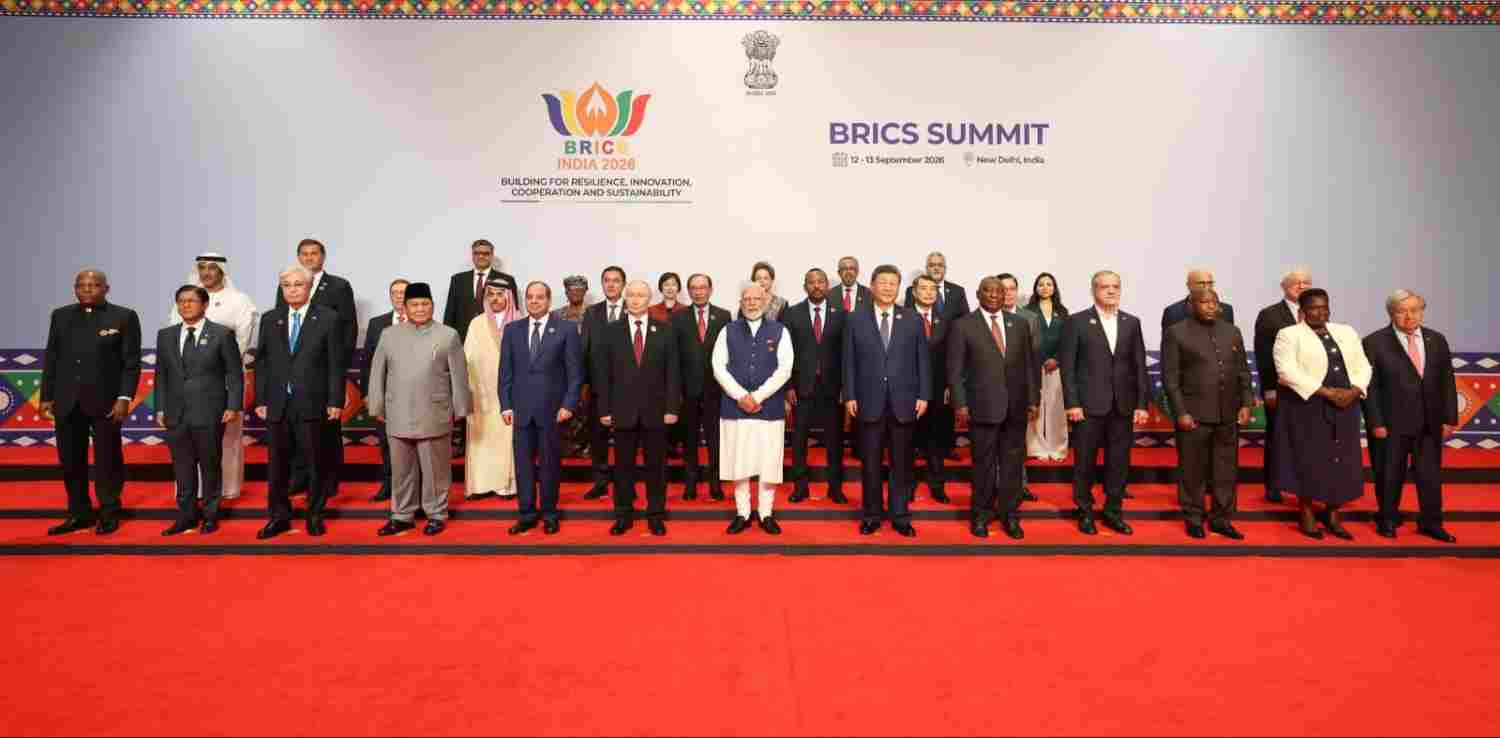
Prime Minister Narendra Modi undertook an intense diplomatic marathon during the 18th BRICS Summit in New Delhi, holding 15 formal bilateral meetings with heads of state and government over three days. The engagements, held alongside the summit, brought together leaders from major powers and emerging economies across Russia, China, Iran, Africa, Southeast Asia, the Gulf and Central Asia.
Beyond the scheduled one-on-one meetings, Modi also participated in several informal “pull-aside” interactions with visiting leaders and representatives of international institutions. The packed schedule highlighted India’s effort to use its BRICS chairmanship not only to advance the grouping’s collective agenda but also to deepen bilateral partnerships on strategic, economic and geopolitical issues.
A High-Intensity Diplomatic Schedule
The three-day diplomatic push came as India hosted the BRICS Summit on September 12 and 13, with the expanded grouping bringing together 11 member countries and 10 partner countries. The summit provided a major platform for discussions on global governance, economic cooperation, technology, development and the interests of the Global South.
For New Delhi, the bilateral meetings offered a parallel diplomatic channel to address country-specific priorities. Discussions covered a broad range of issues, including defence, trade, investment, energy, infrastructure, technology, connectivity, critical minerals and regional security.
The first day of engagements featured Russian President Vladimir Putin and Iranian President Masoud Pezeshkian, along with UN Secretary-General António Guterres.
Modi-Putin Talks Focus on Strategic Partnership
The meeting between Modi and Putin focused on strengthening the long-standing India-Russia strategic partnership. The two leaders reviewed cooperation in defence, energy, trade, infrastructure, technology, critical minerals and civil nuclear energy.
The discussions also touched on the Russia-Ukraine conflict and the situation in West Asia, particularly their implications for maritime trade and the safety of Indian seafarers. Modi reiterated India’s position that dialogue and diplomacy remain essential for resolving conflicts.
The two sides also discussed efforts to expand bilateral trade, with an ambition to take trade between India and Russia to $100 billion by 2030.
Modi’s meeting with Iranian President Masoud Pezeshkian similarly covered bilateral relations, BRICS cooperation and developments in West Asia. India stressed the importance of peace, stability and diplomatic engagement in the region.
Modi-Xi Meeting Draws Global Attention
One of the most closely watched meetings of the summit was the bilateral interaction between Modi and Chinese President Xi Jinping.
Also Read: Amit Shah Sets 2029 Deadline For UCC Rollout Across 21 NDA States
The two leaders discussed the broader India-China relationship, the boundary issue, peace and tranquillity along the border, economic and trade relations, supply chains and people-to-people exchanges.
Modi emphasised that differences between the two countries should not turn into disputes and highlighted mutual respect, sensitivity and interest as important principles for managing bilateral ties. The meeting came amid efforts by both sides to stabilise relations and expand economic and people-to-people engagement.
The India-China engagement therefore emerged as a significant diplomatic moment of the BRICS summit, particularly given the strategic importance of both countries within the expanded grouping.
Strong Outreach to Asia, Africa and the Gulf
Modi’s diplomatic schedule also included important meetings with leaders from Asia, Africa and the Gulf.
The Prime Minister held talks with Malaysian Prime Minister Anwar Ibrahim on trade, investment, defence, semiconductors, infrastructure, digital economy, energy and fintech. His meeting with Ethiopian Prime Minister Abiy Ahmed Ali focused on strengthening India’s engagement with Africa and expanding bilateral cooperation.
BRICS 2026: Xi Jinping Unveils 5 Powerful Initiatives To Strengthen Unite Global South
Modi also met UAE Crown Prince Sheikh Khaled bin Mohamed bin Zayed Al Nahyan, with discussions covering the India-UAE strategic partnership and cooperation in defence, technology, energy, critical minerals and connectivity.
Expanding India’s Global South Engagement
On the third day, Modi held meetings with South African President Cyril Ramaphosa, Kazakh President Kassym-Jomart Tokayev, Philippine President Ferdinand R. Marcos Jr., Egyptian President Abdel Fattah El-Sisi and Burundian President Evariste Ndayishimiye. He also engaged with the leadership of Uganda and Nigeria.
The outreach reinforced India’s growing diplomatic focus on Africa, Central Asia and Southeast Asia. Talks with South Africa carried particular significance because of the country’s role as a founding BRICS member and its importance in advancing Global South priorities.
The meetings with Egypt and Burundi added momentum to India’s African partnerships, while discussions with Kazakhstan strengthened New Delhi’s engagement with Central Asia. The Philippines meeting further expanded India’s Southeast Asian outreach.
BRICS Became a Platform for Wider Diplomacy
The 15 formal bilateral meetings, combined with additional informal interactions, demonstrated how India used its BRICS presidency to pursue both multilateral objectives and national strategic priorities.
With geopolitical tensions continuing to affect energy markets, maritime routes and global supply chains, Modi’s diplomatic marathon allowed India to engage simultaneously with major strategic partners, neighbouring powers and emerging economies.
The summit ultimately served as more than a forum for collective BRICS deliberations. For India, it became a powerful diplomatic opportunity to strengthen partnerships, manage complex relationships and expand its influence across multiple regions.
The breadth of Modi’s engagements underscored New Delhi’s increasingly active role in shaping conversations on global security, economic cooperation, technology, connectivity and the priorities of the Global South.
Click here to join our WhatsApp Channel for real-time news updates and exclusive coverage.