
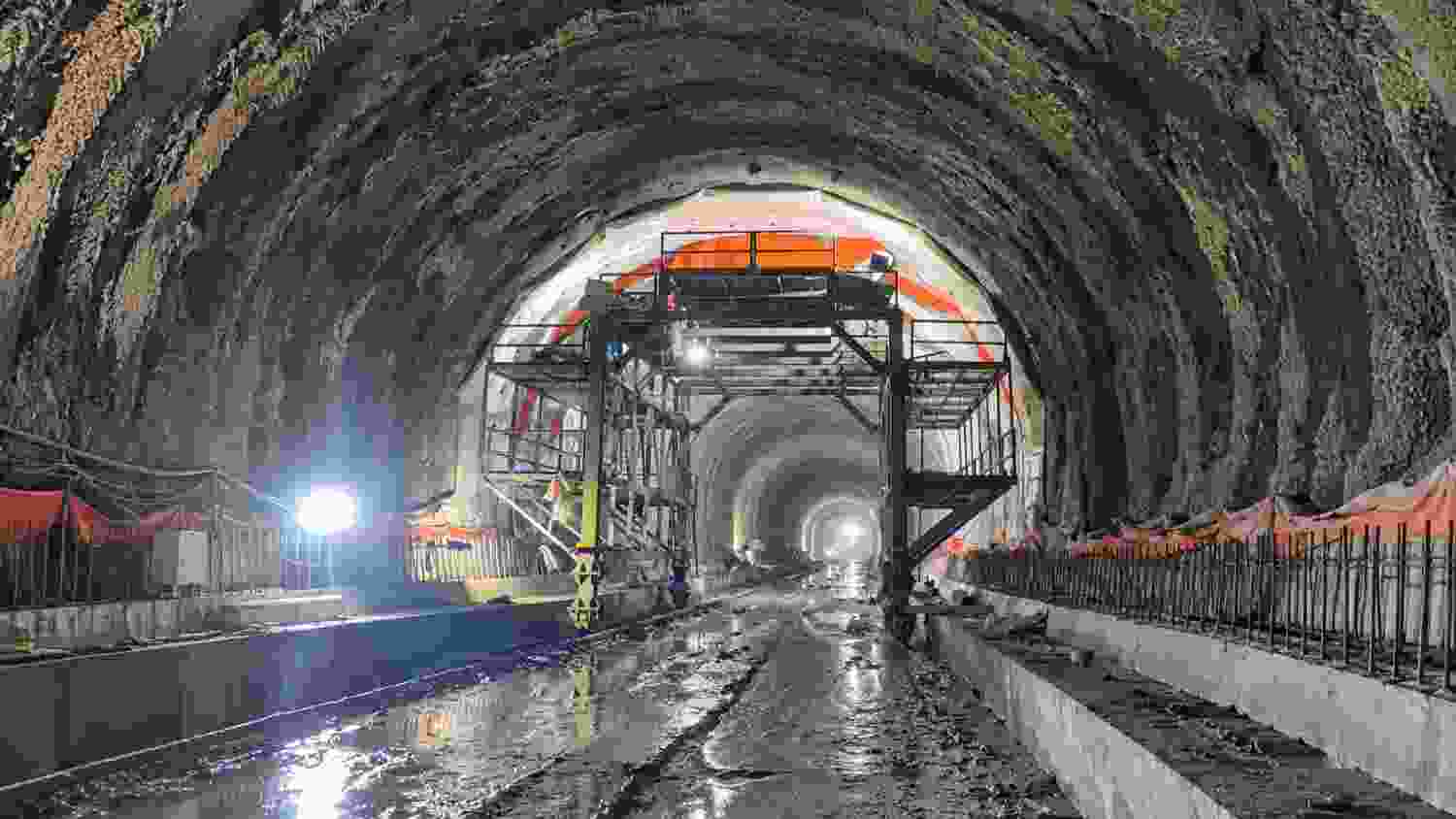
The Rishikesh-Karnprayag New Broad Gauge Rail Line Project has achieved a significant engineering milestone with the final breakthrough of Escape Tunnel-1, taking the total number of tunnel breakthroughs in the ambitious Himalayan railway project to 41.
The breakthrough, achieved on September 11, 2026, marks the completion of the entire 10.847-km length of Escape Tunnel-1. The tunnel is now fully connected from one end to the other and has emerged as the second-longest tunnel under the project, representing another major step towards the completion of one of India’s most challenging railway infrastructure initiatives.
Escape Tunnel-1 Overcomes Difficult Himalayan Geology
The completion of Escape Tunnel-1 assumes particular importance because of the extremely difficult geological conditions encountered during construction.
The tunnel alignment passes through highly tectonised, multi-folded and extensively faulted rock formations. Engineers and construction teams had to work through areas characterised by widespread shearing and locally intense rock crushing, creating complex conditions for excavation and tunnelling operations.
The challenging geology was further complicated by the presence of thick mylonite zones. These zones are primarily associated with the tunnel’s proximity to the Main Boundary Thrust, commonly known as the MBT, a major geological feature in the Himalayan region.
Such conditions require specialised engineering approaches, continuous geological assessment and careful construction planning to maintain safety and stability during tunnelling. The successful completion of the tunnel therefore represents not only progress in terms of project length but also a major achievement in overcoming some of the region’s most demanding underground construction challenges.
41 Tunnel Breakthroughs Mark Steady Project Progress
With the latest breakthrough, the project has now recorded 41 tunnel breakthroughs. The achievement highlights the steady progress being made across the extensive rail corridor being developed through the Himalayan terrain.
The Rishikesh-Karnprayag railway project involves the construction of numerous tunnels and bridges across difficult mountainous landscapes. Tunnelling forms a critical component of the project because of the steep and rugged terrain through which the railway line is being constructed.
The latest achievement strengthens the momentum of the project as construction activities continue towards the remaining sections. According to the project update, five more tunnel breakthroughs are expected to be achieved within the next year.
Once these remaining breakthroughs are completed, the project will move significantly closer to achieving its broader objective of establishing a modern railway connection through the Himalayan region.
Engineering Challenges Define the Himalayan Railway Project
The Rishikesh-Karnprayag New BG Rail Line is among the major railway infrastructure projects requiring extensive tunnelling and engineering expertise because of the region’s difficult topography and geological complexity.
Also Read — BRICS Summit 2026: Xi Jinping Arrives In New Delhi For First India Visit Since 2019
The construction teams have had to navigate fractured and faulted rock formations, folded geological structures and sections where rock conditions can change rapidly. These challenges make tunnelling in the Himalayas substantially more complex than construction in comparatively stable geological environments.
Escape Tunnel-1 is a notable example of these challenges. Its 10.847-km length places it among the most substantial underground structures of the project, while the completion of its full connection demonstrates the progress achieved despite the difficult geological conditions.
The breakthrough also reflects the importance of detailed geological investigations, advanced tunnelling techniques and coordinated project execution in delivering large-scale railway infrastructure in mountainous terrain.
Five More Breakthroughs Expected Within a Year
The project has now entered another important phase, with only five tunnel breakthroughs remaining according to the latest project update.
The expected completion of these breakthroughs within the next year would represent another major step towards the overall completion of the Rishikesh-Karnprayag railway project. Each breakthrough will help establish greater continuity across the railway corridor and bring the ambitious Himalayan connectivity initiative closer to its intended operational goal.
For the teams involved, the 41st breakthrough is therefore more than a numerical milestone. It demonstrates the progress made in overcoming some of the toughest engineering and geological obstacles along the route.
The successful completion of Escape Tunnel-1 reinforces the project’s forward movement and underlines the scale of engineering work being undertaken to bring rail connectivity deeper into the Himalayan region.
A Major Step Towards Himalayan Rail Connectivity
The final breakthrough of Escape Tunnel-1 represents a significant moment for the Rishikesh-Karnprayag New BG Rail Line Project. With 41 tunnel breakthroughs now achieved, the project is steadily advancing towards its next major targets.
The completion of the 10.847-km Escape Tunnel-1, despite the highly tectonised and faulted Himalayan geology, stands as a notable engineering accomplishment.
With five more breakthroughs expected within the coming year, the prestigious railway project is moving closer to its ultimate objective—strengthening rail connectivity across the Himalayas and creating a modern transportation link through one of India’s most challenging terrains.
Click here to join our WhatsApp Channel for real-time news updates and exclusive coverage.