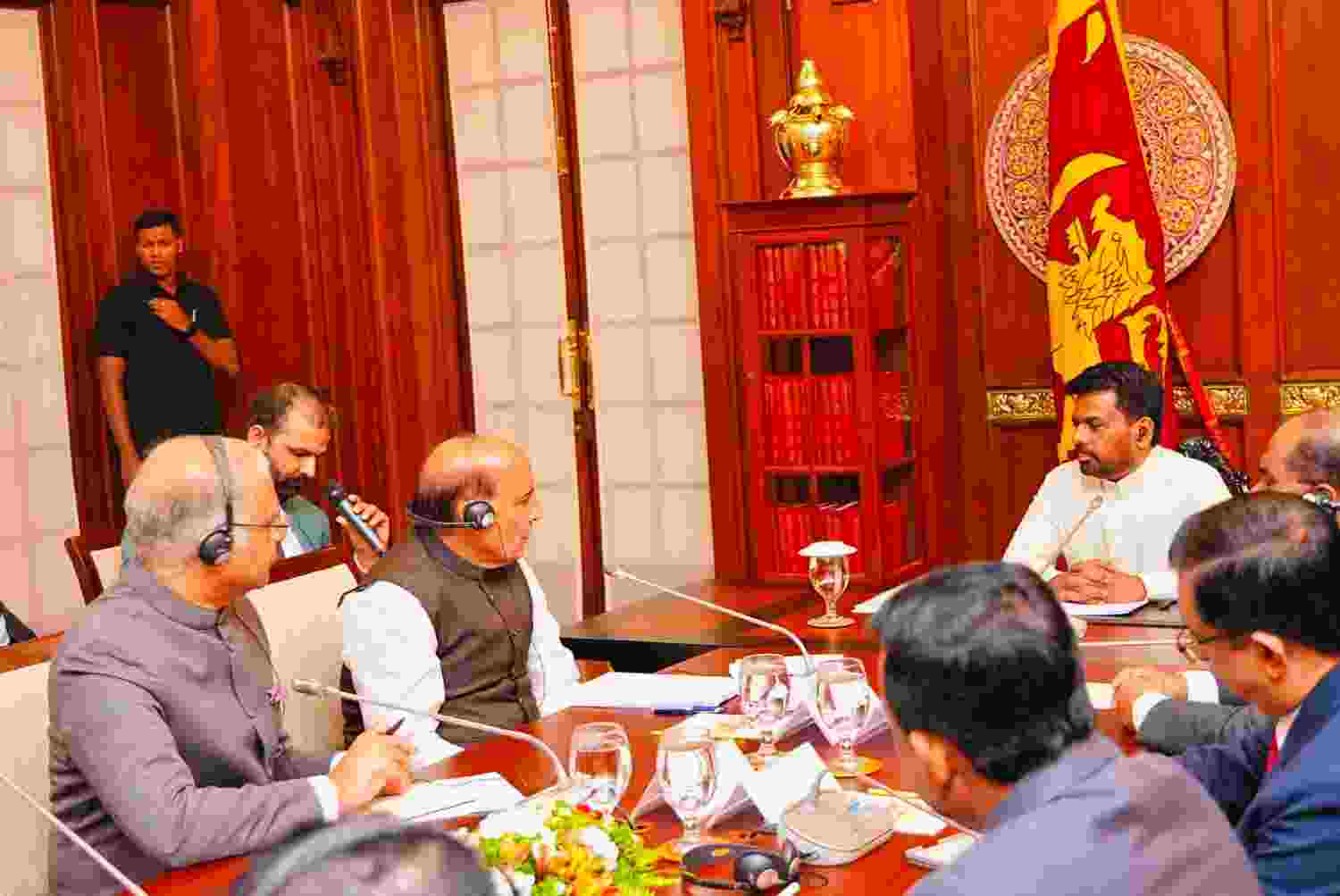
Sri Lankan President Anura Kumara Dissanayake has assured India that Colombo will not allow its territory to be used for activities that could threaten or undermine India’s security interests. The assurance came during his meeting with Defence Minister Rajnath Singh in Colombo on Wednesday, as India and Sri Lanka moved to strengthen their defence and maritime partnership.
The meeting assumed significance amid India’s continued focus on security developments in the Indian Ocean region. The two countries also signed three agreements aimed at expanding defence cooperation, including an arrangement for upgrading air-defence guns supplied by India to the Sri Lankan Air Force.
Dissanayake Gives Strong Security Assurance to India
Dissanayake conveyed that Sri Lanka would ensure its territory was not used for activities inimical to India’s security interests. The assurance comes against the backdrop of New Delhi’s long-standing strategic concerns about developments in the neighbourhood and the growing importance of maritime security in the Indian Ocean.
India and Sri Lanka share close geographical, historical and maritime links, making security cooperation between the two countries strategically important. The latest discussions therefore focused on maintaining mutual trust while strengthening practical defence cooperation.
India-Sri Lanka Defence Cooperation Gets Major Push
During the visit, India and Sri Lanka signed three memoranda of understanding to deepen their defence relationship. One of the agreements covers the upgrading of six L70 air-defence guns operated by the Sri Lankan Air Force.
According to India’s Defence Ministry, the modernisation will strengthen Sri Lanka’s air-defence architecture, particularly for the protection of critical assets. The guns had earlier been supplied to the Sri Lankan Air Force by India, and the latest upgrade will be undertaken through a Government of India grant.
The agreements demonstrate New Delhi’s continuing effort to expand defence cooperation with Colombo while supporting Sri Lanka’s security capabilities.
Maritime Security Remains a Key Priority
The strengthening of maritime cooperation remains central to the India-Sri Lanka relationship. Both countries occupy strategically important positions in the Indian Ocean, where developments involving ports, shipping routes and foreign military or research vessels have wider regional implications.

India has previously expressed concerns over Chinese activities in Sri Lanka, particularly infrastructure and maritime developments involving Chinese interests. New Delhi has closely watched developments surrounding Hambantota port, which came under Chinese control through a 99-year lease in 2017 after Sri Lanka faced difficulties servicing the associated debt.
Against this background, Colombo’s renewed assurance regarding India’s security interests carries strategic importance for New Delhi.
Rajnath Singh Highlights Shared Regional Interests
Rajnath Singh said India and Sri Lanka, as close neighbours and maritime partners, had reaffirmed their commitment to working together for development and the welfare of their people.
He also underlined their shared determination to contribute to security, safety, peace and prosperity in the region. The discussions covered the broader defence partnership between the two countries and reflected the traditionally close relationship between New Delhi and Colombo.
Singh’s visit to Colombo is part of India’s efforts to reinforce defence and maritime ties with Sri Lanka. The visit is scheduled for three days and is focused on strengthening cooperation in these strategic areas.
India-Sri Lanka Ties Expand Beyond Defence
The latest agreements also seek to strengthen institutional and people-to-people links between the two countries.
A separate MoU between India’s National Defence College and Sri Lanka’s National Defence College will promote academic cooperation and knowledge sharing. Another agreement involving the National Cadet Corps will formalise a youth exchange programme between India and Sri Lanka.
The programme provides opportunities for cadets from different countries to participate in NCC activities in New Delhi, creating greater interaction between defence institutions and young participants.
Operation Sagar Bandhu Support Also Highlighted
During the discussions, Dissanayake expressed gratitude to India for its assistance under Operation Sagar Bandhu following Cyclone Ditwah. He also acknowledged New Delhi’s broader rehabilitation package supporting reconstruction efforts across Sri Lanka.
The reference to India’s humanitarian assistance highlights another important dimension of bilateral relations. Alongside defence and maritime cooperation, development assistance and disaster relief have increasingly contributed to the relationship between the neighbouring countries.
The latest talks therefore signal a renewed push to strengthen India-Sri Lanka ties through security cooperation, defence modernisation, institutional exchanges and humanitarian support. Dissanayake’s assurance that Sri Lankan territory will not be used against India is expected to reinforce confidence between the two neighbours at a time when strategic competition in the Indian Ocean remains a major regional concern.
Click here to join our WhatsApp Channel for real-time news updates and exclusive coverage.