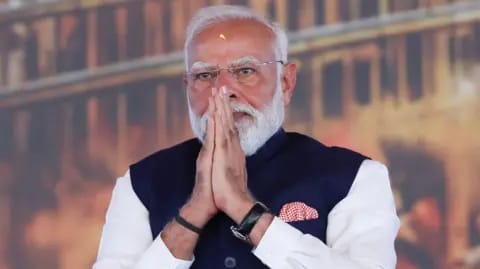
Prime Minister Narendra Modi has welcomed India’s stronger-than-expected 7.8% real GDP growth in the first quarter of financial year 2026-27, describing the performance as a powerful reflection of the country’s collective strength, determination and hard work.
The latest government figures showed that India’s economy expanded by 7.8% during the April-June quarter, outperforming expectations and reinforcing the country’s position among the world’s fastest-growing major economies.
In a video message to citizens, Modi congratulated Indians for the economic performance and linked the growth momentum to the resolve and industriousness of the people. The Prime Minister also used the occasion to underline the importance of strengthening domestic consumption and encouraging Indian-made products.
India records stronger-than-expected GDP growth
According to data released by the Ministry of Statistics and Programme Implementation (MoSPI), India recorded 7.8% real GDP growth in Q1 FY27. The figure came above the Reserve Bank of India’s earlier 7% projection and exceeded market expectations of around 7.1%.
The latest performance represents a strong opening to the new financial year. Although the growth rate was lower than the revised 8.6% recorded in the previous quarter, economists viewed the latest number as evidence of continued resilience in domestic economic activity.
The April-June quarter also marked the fastest pace of expansion in five quarters, according to government-linked economic data. Strong activity across agriculture, manufacturing and services contributed to the overall performance.
Manufacturing and services provide major boost
Manufacturing remained one of the important engines of India’s economic expansion. The sector grew by about 9.2%, highlighting continued industrial activity and investment momentum. The services sector also maintained strong growth, supporting employment, consumption and business activity.
Financial, real estate, information technology and professional services were among the areas recording particularly strong expansion. The financial and related services segment grew by approximately 12.1%, reflecting robust credit demand and continued activity across the financial system.
Gross value added, another important measure of economic activity, increased by 8.2%, further indicating broad-based momentum across the economy.
PM Modi pushes ‘Swadeshi’ amid economic optimism
While celebrating the GDP figures, Modi also called for greater emphasis on self-reliance and Swadeshi consumption.
The Prime Minister urged citizens to support locally produced goods and businesses, arguing that stronger domestic demand can help reinforce India’s economic foundation. He specifically spoke against unnecessary overseas spending, including leisure foreign trips, destination weddings abroad and non-essential gold purchases.
The message comes as the government continues to promote domestic manufacturing, local production and reduced dependence on imported goods.
Also Read —‘Endless To End Of War’: PM Modi’s Powerful Peace Message To Putin During SCO Meet
Modi’s remarks also carried a political edge, as he criticised what he described as pessimistic narratives surrounding India’s economic prospects. He presented the latest growth figures as evidence of the country’s ability to maintain momentum despite difficult global circumstances.
Global challenges remain a major concern
Despite the positive GDP numbers, India’s economic outlook continues to face external risks.
Higher energy prices, geopolitical tensions, trade disruptions and volatility in global markets could put pressure on India’s growth trajectory. The country’s dependence on imported crude oil also leaves the economy vulnerable to sharp movements in international energy prices.
Inflation is another factor policymakers will have to monitor closely. Rising energy and commodity costs could increase pressure on households and businesses if global price shocks persist.
Trade uncertainty is also significant, particularly for export-oriented industries. Analysts have warned that tariffs and changes in global trade conditions could affect sectors such as textiles and other manufacturing industries.
Strong Q1 growth strengthens India’s economic outlook
The latest GDP figures provide the Indian government with a strong economic narrative at the beginning of FY27. Robust consumption, investment, manufacturing and services activity have helped the economy withstand considerable international uncertainty.
For Modi, the 7.8% growth figure represents more than a statistical achievement. His message framed the result as a product of India’s collective effort and resilience.
With domestic demand remaining relatively strong and investment activity improving, economists believe India has maintained considerable growth momentum. However, sustaining that pace will depend on managing inflation, energy costs, global trade risks and employment challenges.
The latest figures nevertheless offer a positive signal for the Indian economy. With 7.8% GDP growth in Q1 FY27, India has once again demonstrated considerable economic resilience, while the government faces the challenge of converting this momentum into sustained, broad-based and inclusive growth.
Click here to join our WhatsApp Channel for real-time news updates and exclusive coverage.