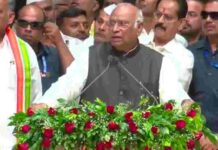
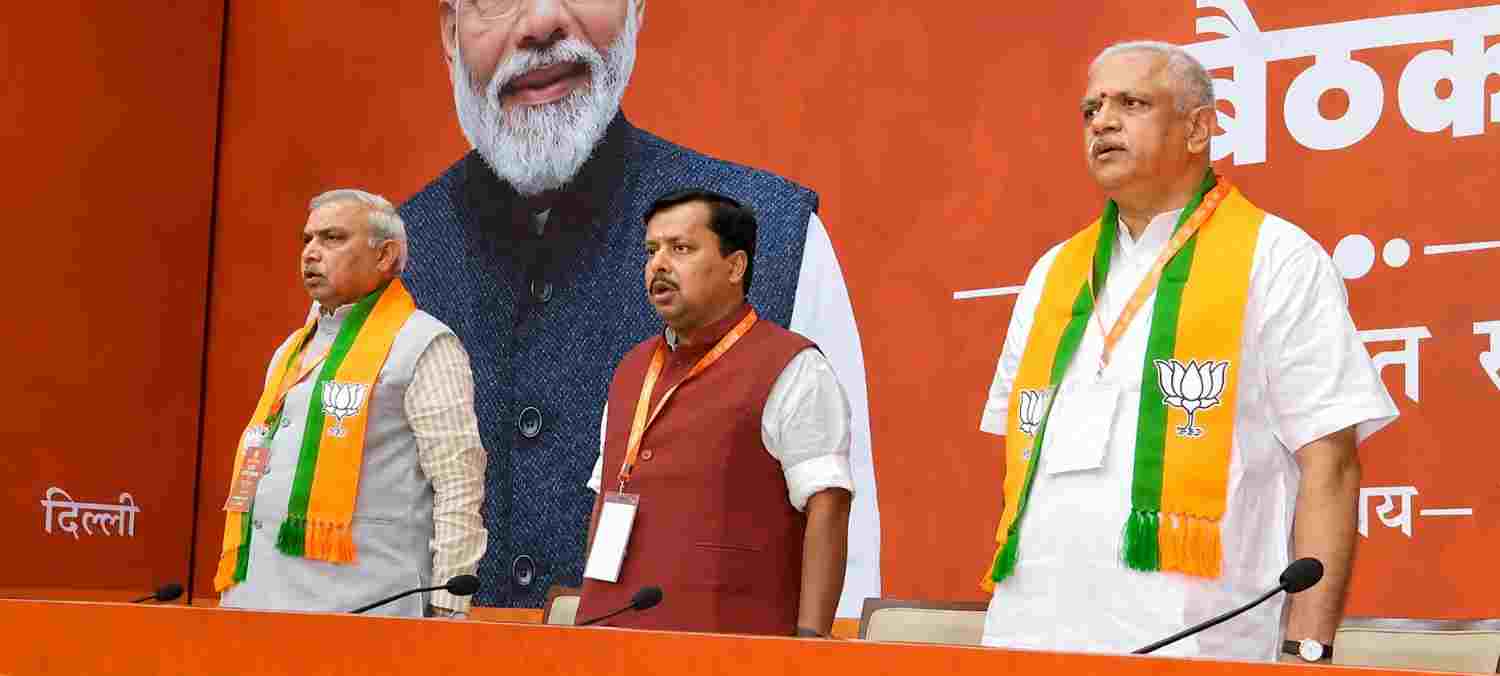
The political battle over Vande Mataram intensified on Saturday after the Bharatiya Janata Party (BJP) passed a resolution defending the complete version of India’s National Song and strongly condemned the Congress Working Committee’s decision to continue singing only its first two stanzas at party programmes. The BJP said there would be “no compromise” on the honour, dignity and historical legacy of Vande Mataram.
The resolution was adopted at a BJP meeting chaired by party president Nitin Nabin at the party headquarters. Before the meeting, BJP leaders reportedly recited all six stanzas of Vande Mataram, underlining the party’s position that the complete composition represents an important part of India’s national consciousness and freedom struggle.
BJP Targets Congress Over Two-Stanza Decision
The latest confrontation follows the Congress Working Committee’s August 19 decision to retain its long-standing practice of singing only the first two stanzas of Vande Mataram at party events. The Congress cited its 1937 resolution on the issue, maintaining that the two-stanza version would continue to be used during its programmes.
The BJP has sharply objected to that decision. The party argues that Vande Mataram is much more than a ceremonial song and represents the sacrifices, aspirations and national spirit associated with India’s freedom movement.
According to the BJP, restricting the song to two stanzas undermines the significance of its complete historical composition. The party has vowed to make the issue a major political and public campaign.
BJP Announces Nationwide Campaign
As part of its response, the BJP announced plans for a nationwide campaign highlighting the history, importance and legacy of Vande Mataram. A major focus of the campaign will be educating younger generations about the song’s role in India’s independence movement and its place in the country’s national heritage.

The BJP’s resolution reportedly stresses that the complete six-stanza composition should be respected and protected from what the party describes as political or communal considerations.
The move is expected to keep the controversy alive across the country, particularly as the BJP and Congress continue to differ sharply over the interpretation and use of national symbols.
Why the Vande Mataram Controversy Began
Vande Mataram, written by Bankim Chandra Chattopadhyay, has played a prominent role in India’s political and cultural history. The song became closely associated with the freedom movement and emerged as a powerful expression of resistance to British colonial rule.
However, the complete composition has also been the subject of historical debate because some of its later stanzas contain religious imagery. In 1937, the Congress adopted the first two stanzas for use at public gatherings after discussions surrounding concerns raised by sections of the Muslim community.
Also Read: 31-Year-Old Adobe Techie Brutally Killed In Delhi; Wife’s Family Detained
The Congress has continued to defend that historical position, arguing that its decision is rooted in a long-established practice rather than any attempt to disrespect the National Song.
The BJP, however, views the present controversy differently and has accused the opposition party of diminishing the importance of a symbol associated with the freedom struggle.
National Song Versus National Anthem
Vande Mataram holds the status of India’s National Song, while Jana Gana Mana is the National Anthem. The Constituent Assembly accorded Vande Mataram an honoured status on January 24, 1950, recognising its historic contribution to India’s freedom struggle.
The distinction between the National Song and National Anthem has become particularly significant in the current political debate. The BJP has repeatedly emphasised that Vande Mataram carries an enduring national significance and should not be reduced to a political controversy.
The Congress, meanwhile, has maintained that its two-stanza practice is based on its 1937 resolution and historical considerations.
Political Battle Intensifies
The dispute has already triggered sharp exchanges between leaders of the two parties. BJP president Nitin Nabin has strongly criticised the Congress position, while Union Home Minister Amit Shah has also attacked the decision to limit the song to two stanzas. Congress leaders have defended their party’s position and questioned the BJP’s interpretation of the issue.
The controversy has also spilled beyond party headquarters. Political tensions surrounding Vande Mataram have surfaced in state legislatures, with a clash over the issue contributing to disruption in the Himachal Pradesh Assembly.
The BJP’s latest resolution is therefore likely to give the dispute a broader national dimension. By announcing a nationwide campaign, the ruling party is seeking to turn the issue into a larger debate about patriotism, national identity and respect for symbols associated with India’s independence movement.
For the Congress, the challenge will be to explain its historical position while responding to the BJP’s increasingly aggressive campaign. With both parties taking firm positions, Vande Mataram has emerged as a fresh flashpoint in India’s political discourse.
The BJP has made clear through its resolution that it intends to pursue the issue nationally, while the Congress remains committed to its established two-stanza practice at party events. The dispute is consequently set to remain a prominent political issue in the days ahead.
Click here to join our WhatsApp Channel for real-time news updates and exclusive coverage.