
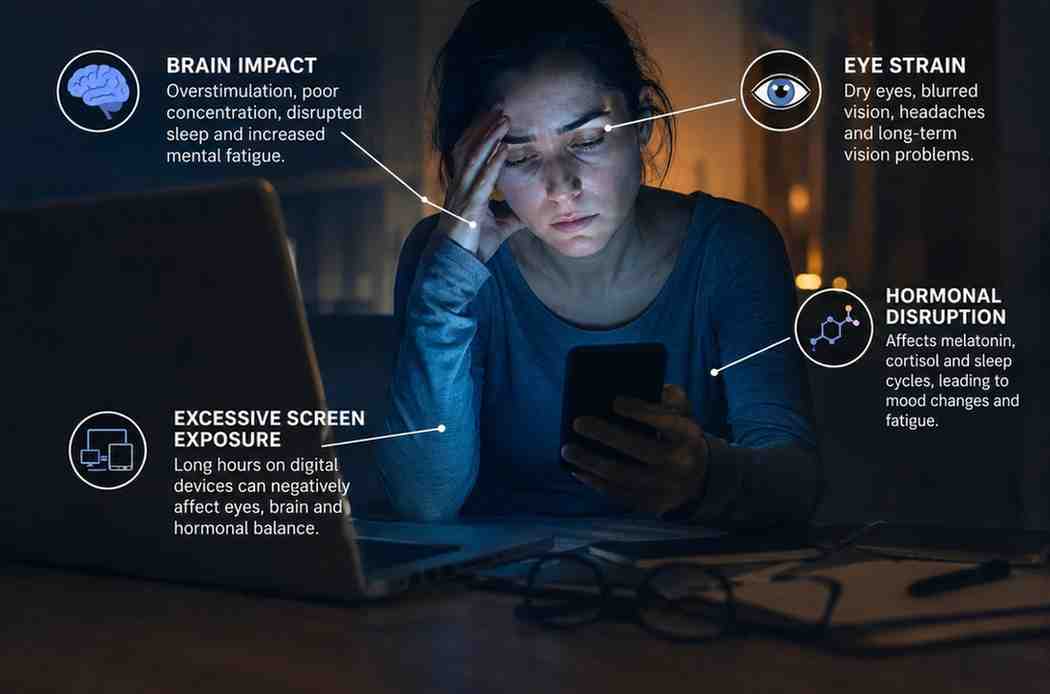
Excessive time can affect your eyes, brain, hormones and sleep, with prolonged smartphone and digital-device use linked to eye strain, disrupted sleep, reduced attention and circadian rhythm changes.
Screens have become inseparable from modern life. Smartphones, computers, tablets and televisions are now used for education, employment, entertainment, communication and even relaxation. But as daily exposure continues to rise, researchers are increasingly examining what prolonged use may mean for the eyes, brain, hormones and overall biological clock.
The issue, however, is more complicated than simply declaring screens “dangerous.” Scientific evidence does not show that ordinary smartphone use destroys the brain or permanently damages the eyes. Instead, growing evidence points toward problems associated with prolonged, uninterrupted and especially late-night exposure.
Eyes: Digital Strain Is The Immediate Warning
One of the most common consequences of prolonged use is digital eye strain, sometimes called computer vision syndrome.
People who spend several hours looking at screens may experience dry or burning eyes, redness, blurred vision, headaches, difficulty focusing and general eye fatigue.
One major reason is reduced or incomplete blinking. When concentrating on digital content, people often blink less effectively, allowing tears to evaporate more rapidly from the surface of the eye. The result can be dryness and irritation.
The 20-20-20 approach can help: after about 20 minutes of work, look at something roughly 20 feet away for at least 20 seconds. Regular blinking, appropriate viewing distance, reduced glare and adequate room lighting can also reduce discomfort.
Children require particular attention. Research has found an association between higher digital-screen exposure and myopia (short-sightedness) in children and adolescents. However, exposure is only one part of a much larger picture involving genetics, near-work habits and time spent outdoors.
Importantly, the claim that normal smartphone use literally “burns the retina” or permanently destroys eyesight is not established by current evidence.
Brain: Attention, Memory And Sleep Under Pressure
The brain may be affected less by the physical itself and more by the behaviour surrounding screen use.
Constant notifications, short-form videos, social-media feeds and rapid switching between applications can repeatedly interrupt attention. Instead of maintaining concentration on one task, the brain is encouraged to move rapidly between competing sources of information.
This does not mean that screens permanently destroy attention or intelligence. Educational and purposeful use can be valuable. The concern is particularly strong when use becomes compulsive, highly stimulating or interferes with normal activities.
Sleep may be the most important connection between excessive use and brain function.
Late-night exposure combines bright light with mental stimulation. Social media, gaming, videos and emotionally engaging content can keep the brain active when it should be preparing for sleep. Light exposure at night can also interfere with the body’s circadian system and melatonin timing.
Poor or insufficient sleep can subsequently affect attention, learning, memory, reaction time and emotional regulation.
This creates a potentially damaging cycle:
Excessive screen use → delayed sleep → sleep deprivation → poorer concentration → fatigue → greater dependence on stimulating digital content.
Some neuroimaging studies have also reported associations between high or problematic digital-media exposure and differences in brain structure or connectivity, particularly in younger populations. However, these findings do not prove that directly cause brain damage. Researchers continue to investigate whether the observed differences result from screen exposure, other lifestyle factors, pre-existing characteristics or a combination of factors.
Hormones: The Body’s Clock May Be The Key
The hormonal concern surrounding is closely connected to the circadian rhythm, the body’s approximately 24-hour biological timing system.
The hormone most clearly linked with nighttime light exposure is melatonin.
Melatonin normally rises in the evening as darkness signals the body to prepare for sleep. Bright light reaching the eyes at night can suppress or delay this biological signal.
Also Read: Toxic Trailer Explodes: Yash Faces His Darkest Enemy Yet Onscreen
Therefore, late-night screen use may contribute to:
Screen exposure at night → altered light signal → delayed melatonin response → later sleep → disrupted sleep rhythm.
This does not mean that every phone user develops a hormone disorder.
Other hormones can also be affected indirectly when sleep and circadian rhythms are repeatedly disturbed. Cortisol, for example, normally follows a daily pattern, generally being higher around the morning and lower at night. Poor sleep and circadian disruption can interfere with normal physiological rhythms.
Growth hormone is another consideration, particularly for children and adolescents, because important growth-hormone secretion occurs during sleep. Therefore, chronic sleep disruption may interfere with the conditions necessary for healthy hormonal rhythms.
Claims that ordinary smartphone use directly causes major testosterone loss, infertility or permanent hormonal damage, however, currently go beyond what the evidence can establish.
The Hidden Problem: What Screen Time Replaces
Perhaps the greatest health concern is not the screen itself but what excessive screen use replaces.
Hours spent scrolling can mean fewer hours spent:
- Sleeping
- Walking
- Exercising
- Playing outdoors
- Reading
- Talking face-to-face
- Resting without digital stimulation
This creates a broader lifestyle problem.
Long periods of sitting associated with recreational screen use can contribute to physical inactivity, while insufficient sleep can affect metabolic and cognitive health.
For children, the concern becomes even greater because their brains, eyes, sleep patterns and behavioural habits are still developing.
Not All Screen Time Is Equal
A crucial distinction is often missing from public discussions.
An hour spent attending an online class, editing a document or researching a topic is not necessarily equivalent to an hour of compulsive short-video scrolling.
Purpose, duration, timing, posture, viewing distance, content and breaks all matter.
The greatest concern is the combination of long uninterrupted sessions, nighttime use, inadequate sleep, close viewing distance and insufficient physical activity.
What Can Users Do?
Experts generally recommend practical rather than extreme solutions.
Take regular visual breaks. Follow the 20-20-20 principle during prolonged screen work. Keep screens at a comfortable distance and avoid excessive brightness or glare.
For sleep, consider creating a screen-free period before bedtime, particularly if nighttime device use is interfering with sleep. Keeping the phone away from the bed can also reduce the temptation to continue scrolling.
Children should have opportunities for outdoor activity, physical movement, face-to-face interaction and adequate sleep rather than allowing recreational screen use to dominate their day.
The Bottom Line
Screens are not inherently poisonous, and current science does not justify claims that ordinary smartphone use “destroys the brain.”
But excessive digital exposure can become a serious health issue when it produces eye strain, disrupted sleep, fragmented attention, sedentary behaviour and circadian disturbance.
The modern challenge, therefore, is not necessarily to eliminate screens. It is to learn how to use them without allowing them to control our sleep, attention, movement, eyes and biological rhythms.
In a world where screens are becoming unavoidable, the most valuable skill may not be avoiding technology altogether—but knowing when to look away, switch off and let the body recover.
Click here to join our WhatsApp Channel for real-time news updates and exclusive coverage.