
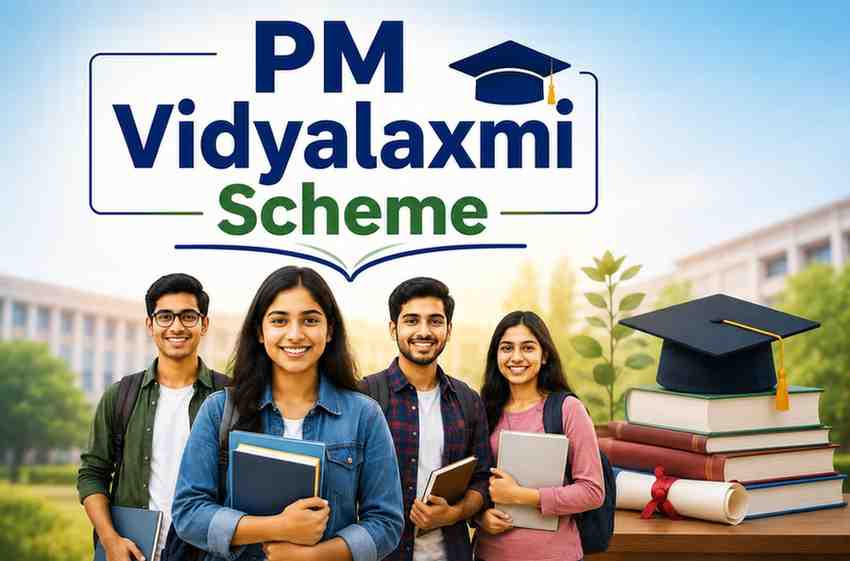
The Government of India has highlighted the impact of the Pradhan Mantri (PM) Vidyalaxmi Scheme, describing it as a major initiative aimed at ensuring that deserving students are not denied higher education because of financial constraints. The scheme offers collateral-free and guarantor-free education loans while extending interest subvention benefits to eligible students from lower and middle-income families.
A Major Push for Inclusive Higher Education
According to the Ministry of Education, the PM Vidyalaxmi Scheme seeks to improve access to quality higher education for students admitted to top-ranked institutions across the country. It supports students who secure admission on merit but struggle to arrange the financial resources required to continue their education.
The government noted that the initiative aligns with the goals of the National Education Policy (NEP) 2020 and Sustainable Development Goal 4, which promotes inclusive and equitable quality education for all.
Key Benefits Under the Scheme
The scheme currently covers 1,425 Quality Higher Educational Institutions (QHEIs) across India, including both public and private institutions.
Students admitted on merit can avail:
- Collateral-free and guarantor-free education loans.
- A 75% government credit guarantee for loans up to ₹7.5 lakh.
- 3% interest subvention on education loans up to ₹10 lakh for students whose annual family income is up to ₹8 lakh.
- A fully digital application process through a unified online portal for loan applications, tracking, interest subvention claims, and grievance redressal.
However, admissions secured under management quota or NRI quota are not eligible for these benefits.
Flexible Loan Structure
The government stated that there is no upper limit on the education loan amount under PM Vidyalaxmi. The final sanctioned amount depends on tuition fees, hostel charges, living expenses, laptops, and other approved educational costs.
Education loans are provided through Scheduled Banks, Regional Rural Banks (RRBs), and Cooperative Banks participating in the scheme. Interest rates are capped at the lending bank’s Externally Benchmarked Lending Rate (EBLR) plus 0.5%, making these loans more affordable than conventional education loans.
Students can repay the loan over a period of up to 15 years, excluding the moratorium period, which covers the duration of the course plus one additional year.
Interest Support for Eligible Families
The scheme supplements the existing PM-USP Central Sector Interest Subsidy Scheme (CSIS).
Students with annual family income below ₹8 lakh receive a 3% interest subvention during the moratorium period on education loans up to ₹10 lakh.
Meanwhile, students with family income up to ₹4.5 lakh continue to receive full interest subsidy under the PM-USP CSIS for eligible technical and professional courses.
The government has allocated ₹3,600 crore for PM Vidyalaxmi between 2024-25 and 2030-31, with an estimated seven lakh students expected to benefit during this period.
Eligibility Criteria
To receive benefits under the scheme, students must:
- Secure merit-based admission to designated Quality Higher Educational Institutions.
- Remain enrolled throughout the course.
- Maintain satisfactory academic performance from the second year onward.
- Register using Aadhaar on the PM Vidyalaxmi portal.
The interest subvention and credit guarantee benefits can be availed only once, whether for an undergraduate, postgraduate, or integrated course.
Growing Reach Across India
The government reported encouraging progress in the scheme’s implementation.
During FY 2025-26, the PM Vidyalaxmi portal received 645,514 education loan applications across various education loan schemes. Of these, 110,667 applications were specifically submitted under PM Vidyalaxmi.
Authorities sanctioned 70,852 loans, while 67,728 loans had already been disbursed.
Also Read: Bhiwandi Tragedy: 9 Killed In Deadly Building Collapse, Rescue Race Continues
The digital platform also enables students to monitor applications, seek interest subvention, and raise grievances through a transparent online system.
Promoting Gender and Social Inclusion
The scheme has also demonstrated broad participation across different sections of society.
In FY 2025-26, 368,742 men and 276,764 women applied for education loans. Authorities sanctioned 203,438 loans for men and 158,629 loans for women.
Applications were received from students belonging to Economically Weaker Sections (EWS), Other Backward Classes (OBC), Scheduled Castes (SC), Scheduled Tribes (ST), Persons with Disabilities (PwD), and other social categories, reflecting the programme’s inclusive approach.
### A Step Towards Educational Equity
The government believes the PM Vidyalaxmi Scheme represents a significant step towards reducing financial barriers in higher education. By combining collateral-free loans, targeted interest support, and a transparent digital platform, the initiative aims to ensure that talented students can pursue quality education regardless of their economic background.
Officials say the scheme supports the broader objectives of NEP 2020 while strengthening India’s efforts to build a skilled and future-ready workforce through equitable access to higher education.
Click here to join our WhatsApp Channel for real-time news updates and exclusive coverage.