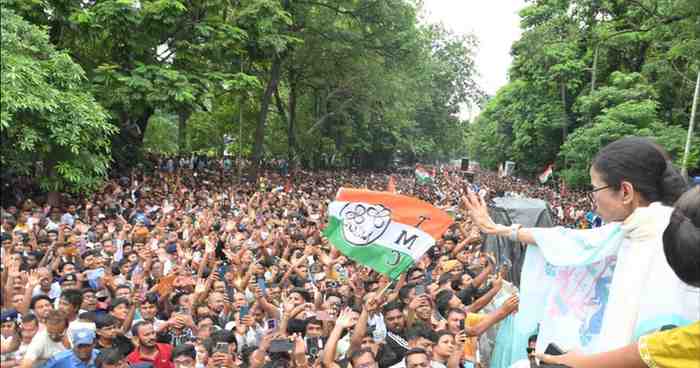
KOLKATA: The Trinamool Congress’(TMC) annual July 21 Martyrs’ Day programme took on a dramatically different character this year, with rival factions of the party holding separate events in Kolkata following the party’s internal split. What was once a single show of strength evolved into parallel political gatherings led by former West Bengal Chief Minister and TMC supremo Mamata Banerjee and the faction headed by Leader of Opposition Ritabrata Banerjee.
A New Political Reality
For decades, the July 21 Martyrs’ Day rally has been one of West Bengal’s most significant political events, commemorating those killed during the 1993 police firing on a Youth Congress demonstration led by TMC leader Mamata Banerjee. Over the years, the event became synonymous with the TMC and served as a platform to outline the party’s political roadmap.
This year, however, the rally reflected the changing political landscape in Bengal. Following the split within the TMC after the Assembly elections, multiple factions claimed ownership of the party’s legacy, resulting in separate observances of Martyrs’ Day.
Contrasting Gatherings in Kolkata

Mamata Banerjee addressed supporters at her faction’s programme, where she appealed for opposition unity against the BJP while defending her political leadership. During her speech, she also criticized party rebels and maintained that those unwilling to remain with her camp should openly align with the BJP rather than create internal divisions.
Meanwhile, the Ritabrata Banerjee-led faction organised its own Martyrs’ Day event, presenting itself as the legitimate continuation of the Trinamool Congress. Leaders from the faction had spent several days preparing for the programme, mobilising supporters from multiple districts to demonstrate organisational strength.
Symbolism Beyond Crowd Size
Political observers noted that the importance of this year’s programmes extended beyond attendance figures. Both camps sought to establish their credibility before party workers and the public, using the annual event to reinforce competing narratives about the future of the Trinamool Congress.r
Read Also: “We’ll Be Hitting That Area Pretty Soon,” Trump Warns Iran Over Nuclear Site
The parallel rallies also highlighted how a political tradition built around a shared historical event has now become a platform for rival factions to assert their individual identities.
Legal and Administrative Developments
Preparations for the July 21 observances were influenced by court proceedings and administrative decisions. Earlier, the Calcutta High Court had granted permission for the annual rally with specific conditions, including a change in venue from its traditional location. The court also imposed restrictions on attendance to ensure law and order.
Reports also indicated that different factions sought separate permissions from authorities, adding another layer of complexity to organising the commemorative events.
Historical Importance of July 21
The significance of July 21 dates back to 1993, when a Youth Congress march demanding compulsory voter identity cards ended in police firing near the Writers’ Building. The deaths during the protest became a defining moment in Mamata Banerjee’s political career and eventually gave rise to the annual Martyrs’ Day rally after the formation of the Trinamool Congress.
Over the years, the event has been used to announce political strategies, organisational changes and electoral campaigns, attracting supporters from across West Bengal.
Political Messages from Both Camps
Mamata Banerjee’s address focused on maintaining unity among opposition parties and strengthening resistance against the BJP. She also reiterated that discipline would remain a priority within her organisation and ruled out any return for leaders who had left her camp.
On the other hand, the Ritabrata Banerjee-led faction attempted to project itself as an inclusive political platform, earlier stating that anyone wishing to participate in its Martyrs’ Day programme would be welcome. The camp has consistently argued that it represents the genuine continuation of the Trinamool Congress after the party’s internal reorganisation.
A Defining Moment for Bengal Politics
The parallel observance of July 21 underscored the transformation of West Bengal’s political landscape. What was once a unified annual rally has become a visible demonstration of the divisions within one of the state’s most influential political parties.
While both factions invoked the legacy of the 1993 movement, the separate programmes highlighted competing visions for the future of the Trinamool Congress. Political analysts believe the impact of these developments could shape opposition politics in West Bengal in the months ahead as both camps continue to vie for organisational legitimacy and public support.
Click here to join our WhatsApp Channel for real-time news updates and exclusive coverage.