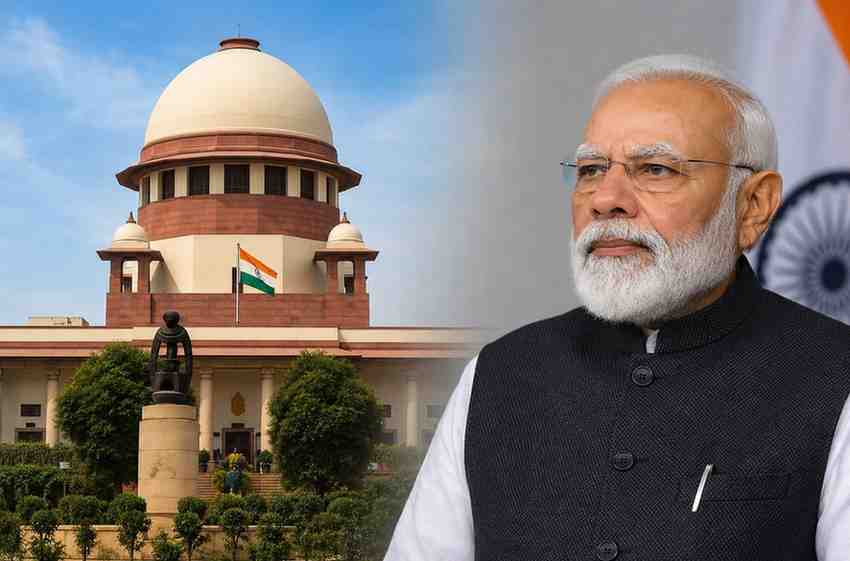
The Centre on Friday informed the Supreme Court that Prime Minister Narendra Modi is personally overseeing the reform and re-examination process related to the National Eligibility cum Entrance Test (NEET)-UG following the recent paper leak controversy that triggered nationwide concern among medical aspirants.
During the hearing on petitions linked to alleged irregularities in NEET-UG 2026, Solicitor General Tushar Mehta told the apex court that the government was taking the matter with utmost seriousness and had already introduced fresh safeguards to prevent any recurrence.
“Prime Minister is personally supervising so that there is no lacunae,” Mehta submitted before the bench, according to reports.
The Centre further informed the court that new mechanisms had been implemented for the NEET-UG examination scheduled for June 21.
Expressing concern over the impact of the controversy on students, the Supreme Court observed that such incidents could deeply affect young aspirants. “It is actually very traumatic if something like this happens. We should not disappoint our youngsters,” the bench remarked.
Responding to the court’s concerns, the Centre stated that the government was fully aware of the emotional and academic consequences faced by students. “We are dealing with youths, the government is seriously concerned about their concerns,” the Centre said.
The National Testing Agency (NTA), in an affidavit submitted before the apex court, detailed a wide-ranging overhaul of its examination and security framework after the NEET-UG 2026 paper leak and subsequent cancellation of the examination.
The affidavit was filed in response to petitions by the Federation of All India Medical Association (FAIMA) and the United Doctors Front (UDF), which sought major reforms in the functioning of the NTA over alleged lapses in the conduct of the examination.
According to the NTA, a High-Powered Steering Committee (HPSC) reviewed preparations for NEET-UG 2026 during a meeting held on April 17 and proposed extensive reforms covering pre-exam, during-exam and post-exam procedures.
The agency said the measures included mandatory CCTV verification at examination centres and preservation of footage for at least 90 days. Mock drills were conducted at centres, while weather-related contingency plans, power backup verification, emergency medical facilities and detailed inspections of examination venues were also introduced.
The committee additionally recommended forensic analysis of CCTV footage after the examination to detect suspicious behaviour or irregularities that may have gone unnoticed during real-time monitoring.
The NTA also informed the court that the steering committee would meet again after the conclusion of NEET-UG 2026 to evaluate whether future examinations should be conducted in Computer-Based Test (CBT) mode instead of the traditional Pen-and-Paper Test (PPT) format. The final decision would be taken in consultation with the Ministry of Health and Family Welfare.
In its affidavit, the NTA said several recommendations made earlier by the High-Level Committee of Experts (HLCE) had already been implemented, while the remaining suggestions were in advanced stages of execution.
As part of the institutional restructuring, the agency stated that 16 senior-level positions, including Director and Joint Director posts, had been created. Two officers of Joint Secretary rank were appointed as Additional Director Generals to supervise technology operations and examination security.
The NTA further noted that a Secretary-level officer assumed charge as Director General of the agency in March 2026.
To strengthen examination management systems, experts from institutions including the IITs, University Grants Commission (UGC), Central Board of Secondary Education (CBSE), Kendriya Vidyalaya Sangathan (KVS) and IGNOU have also been brought into the process.
On coordination and surveillance, the agency told the court that State-Level Coordination Committees (SLCCs) and District-Level Coordination Committees (DLCCs) had been established across the country to ensure secure conduct of examinations.
According to the affidavit, by the time NEET-UG 2026 was held on May 3, a total of 18 SLCCs and 621 DLCCs had been operationalised nationwide. These committees include officials from district administrations, police departments, intelligence agencies, the National Informatics Centre (NIC) and the NTA to strengthen coordination and monitoring during examinations.
The matter remains under consideration before the Supreme Court as the Centre and the NTA continue to defend the reforms introduced after the paper leak controversy.