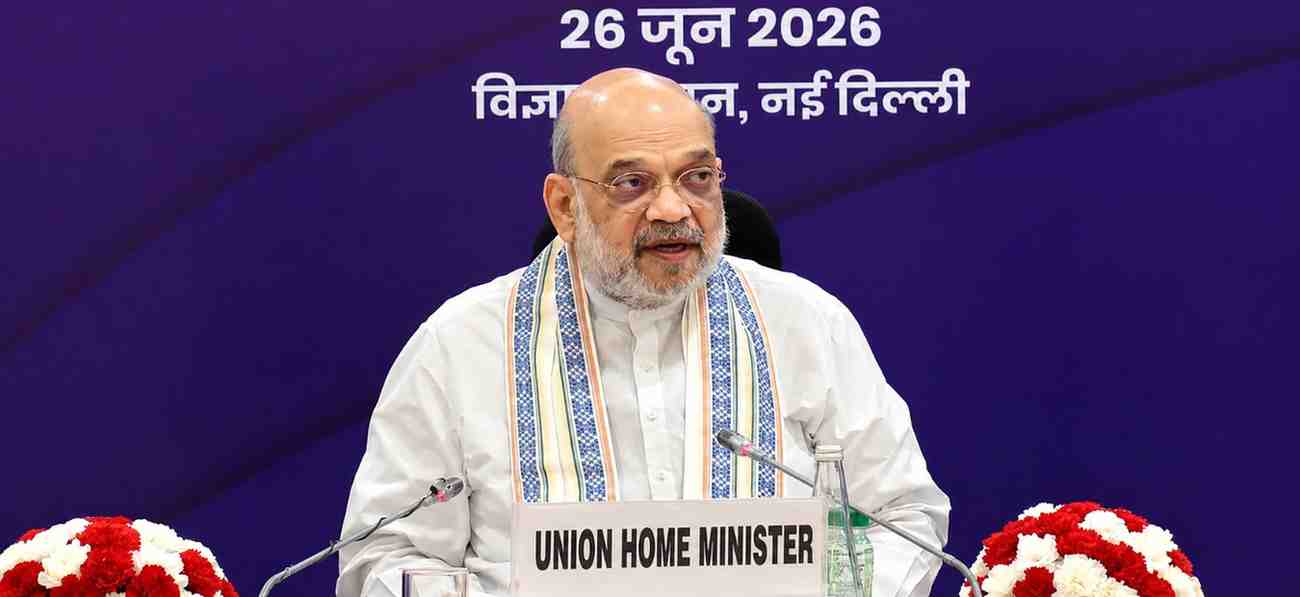
NEW DELHI: Union Home Minister and Minister of Cooperation Amit Shah on Friday unveiled an ambitious national roadmap to intensify India’s fight against narcotics, declaring that the country’s anti-drug campaign will now be driven by the three-pronged strategy of “Detect, Disrupt and Destroy.” Addressing the 10th Apex Level Meeting of the Narco-Coordination Centre (NCORD) in New Delhi, Shah said the coming three years would be crucial in determining whether India succeeds in defeating the menace of drug addiction and trafficking.
During the meeting, the Home Minister released the Vision Document on Drug Control (2026–2029), launched the Online Drugs Disposal Fortnight Campaign, unveiled the NCB Annual Report 2025, and virtually inaugurated new Narcotics Control Bureau (NCB) zonal offices in Jammu and Guwahati.
Three-Year Roadmap Against Drugs
Amit Shah said the government’s roadmap has been designed to dismantle the entire drug ecosystem by targeting every link in the supply chain. Stressing that drug trafficking has become a multidimensional challenge involving organised crime, cross-border networks, narco-terror financing and emerging technologies, he said India must respond with intelligence-driven, technology-enabled and coordinated action.
According to Shah, the anti-drug campaign will focus on detecting drug networks, disrupting their operations and destroying them permanently through sustained enforcement.
Vision Document Sets Four Strategic Pillars
The newly launched Vision Document for 2026–2029 outlines four key pillars to strengthen India’s narcotics control framework.
The first pillar focuses on enforcement, intelligence gathering and coordinated operations. The second targets precursor chemicals and synthetic drugs, which have emerged as significant threats in recent years. The third pillar aims to reduce demand through awareness campaigns, de-addiction and rehabilitation, while the fourth emphasises capacity building, inter-agency coordination and continuous monitoring.
The Home Minister said the strategy follows both a “Whole of Government” and a “Whole of Society” approach, requiring active participation from central ministries, state governments, educational institutions, communities and citizens.
Massive Drug Disposal Campaign Launched
Shah also launched the Online Drugs Disposal Fortnight Campaign, under which authorities have set a target of destroying more than 2,09,500 kilograms of narcotic substances valued at over ₹6,000 crore.
Calling it a significant achievement, he said the destruction of such a large quantity of seized narcotics demonstrates the government’s commitment to preventing drugs from re-entering illegal markets.
Technology-Driven Drug Networks Pose New Challenge
The Home Minister warned that drug traffickers are increasingly using advanced technologies such as drones, encrypted communication, darknet platforms, cryptocurrency payments, parcel delivery systems and maritime cargo routes.
He said these developments have transformed narcotics trafficking into a technology-driven and network-based crime, requiring law enforcement agencies to adopt equally sophisticated investigative methods.
He stressed the need for extensive use of human intelligence, technical surveillance and community policing to identify and dismantle criminal networks operating from border areas to urban centres.
Stronger Financial Investigations and Faster Trials
Amit Shah directed law enforcement agencies to prioritise financial investigations in major NDPS cases by tracing, freezing and confiscating proceeds of crime.
He said dismantling the financial backbone of drug cartels is essential for permanently weakening organised narcotics networks. The government also plans to strengthen real-time information sharing among enforcement agencies to improve investigations.
The Ministry of Home Affairs is working with High Courts to establish exclusive NDPS courts and ensure speedy trials, adequate judicial capacity and faster convictions in significant narcotics cases.
States Asked to Strengthen Anti-Narcotics Units
The Home Minister urged all states to convert their Anti-Narcotics Task Forces (ANTFs) into full-time, professionally equipped and accountable units.
He also asked state governments to strengthen district and state-level NCORD meetings, appoint dedicated nodal officers for awareness and rehabilitation programmes, and improve prosecution through specialised public prosecutors.
Shah further called for stronger international cooperation by using Red Corner Notices, extradition mechanisms and coordination with the CBI to bring back drug traffickers and gangsters hiding abroad.
Public Awareness and Drug-Free Zones
Recognising that enforcement alone cannot solve the problem, Shah stressed the importance of reducing demand through public participation.
He called for the creation of drug-free campuses and drug-free zones, supported by awareness campaigns involving parents, teachers, educational institutions, youth organisations and community leaders. He also urged the Ministries of Social Justice, Health and Education to expand rehabilitation services, monitor pharmaceutical misuse and strengthen preventive education.
Significant Progress Highlighted
Highlighting the government’s achievements, Shah said that between 2014 and 2026, authorities seized narcotics worth ₹1.84 lakh crore, compared with ₹40,000 crore seized between 2004 and 2014.
He added that drugs worth nearly ₹89,896 crore have been destroyed since 2014, while illegal opium cultivation has also been significantly reduced through large-scale eradication drives. The number of NDPS cases registered and arrests made has also increased substantially during the same period.
Call for Collective Action
Concluding his address, Amit Shah said the battle against narcotics is not only a law enforcement challenge but also a fight to safeguard India’s internal security, social stability, economy and the future of its youth.
Expressing confidence in the new strategy, he said that if the Centre, states and society work together with clear targets and coordinated action, India can decisively weaken drug cartels over the next three years and move closer to the vision of a Nasha Mukt Bharat.