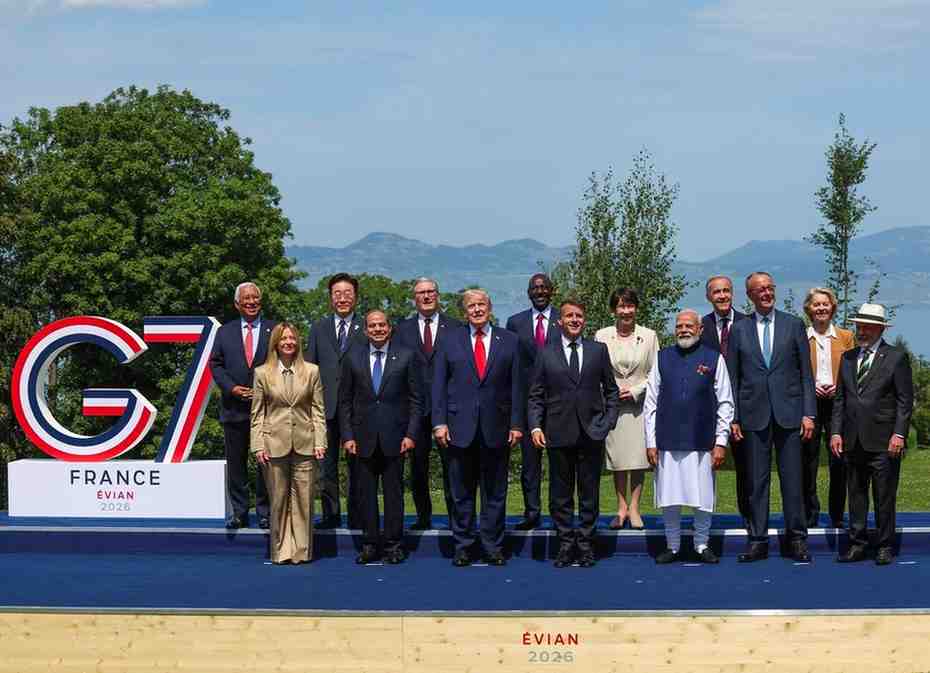
Prime Minister of India Shri Narendra Modi occupying a central seat among world leaders at the G7 Summit was more than a matter of protocol or photography. In global diplomacy, symbolism often carries as much weight as signed agreements, and this image sent a powerful message: India no longer waits for a seat at the table; it has become indispensable to the table itself.
India is not a member of the G7. Yet, over the last decade, every major global forum increasingly revolves around India’s participation. Whether it is climate change, supply chains, energy security, technology, maritime routes, artificial intelligence, or geopolitical stability, no meaningful discussion can ignore New Delhi.
At the summit, Modi sitting beside US President Donald Trump and using the opportunity to raise concerns over maritime security and the safety of seafarers demonstrated India’s evolving diplomatic strategy. It was a reminder that India is no longer a passive observer but an active agenda-setter.
The Power Of Positioning
In international diplomacy, seating arrangements are rarely accidental. Being positioned centrally among leaders from powerful economies such as the United States, France, Germany, Italy, Japan, Canada and the United Kingdom reflected something deeper than protocol courtesy.
It reflected India’s transformation from an emerging economy to a strategic power. Twenty years ago, India attended such meetings seeking investments and recognition. Today, global powers seek India’s cooperation to solve international crises.
The world understands a simple reality without India, many global ambitions cannot succeed. Like, Climate targets need Indi, Supply chain diversification needs India, Indo-Pacific security needs India, Semiconductor expansion needs India, Energy transition also needs. India has become the bridge between developed and developing nations.
Sitting Beside Trump: A Calculated Diplomatic Signal
One image attracted enormous attention Narendra Modi seated beside Donald Trump. However, modern diplomacy should not be reduced to a hug or a handshake. Many observers focused on the absence of the famous Modi-Trump embrace that previously dominated headlines. But diplomacy is evolving. Relationships between countries are measured by strategic outcomes, not body language.
The United States and India today share deeper institutional partnerships than ever before. The two countries cooperate in, Defence manufacturing, Technology transfers, Artificial intelligence, Semiconductor investments, Indo-Pacific security, Counterterrorism efforts.
The absence of a hug does not indicate distance. Mature diplomacy often moves away from spectacle towards substance. The handshake itself represented continuity rather than theatricality. International politics has entered an era where strategic interests outweigh symbolic gestures.
India’s Seafarer Message Was Not Accidental
One of Modi’s important interventions involved maritime security and the protection of seafarers. At first glance, it may appear to be a technical issue. In reality, it is a geopolitical statement.
Nearly 90 percent of global trade moves through sea routes. Conflicts in the Middle East, attacks in strategic waterways and rising geopolitical tensions have threatened international shipping.
India understands that maritime disruptions directly impact Energy prices Food security, Inflation, Global supply chains, Economic stability.
By raising the issue before world leaders, Modi positioned India as a responsible stakeholder rather than a regional power concerned only with its own interests.
India was effectively saying, “Global stability is a shared responsibility, and secure oceans are fundamental to world prosperity.” This is sophisticated diplomacy.
India’s Biggest Strength: Strategic Neutrality
Perhaps India’s greatest diplomatic achievement is maintaining relationships with countries that often disagree with each other.
India simultaneously maintains strong relations with, The United States, Russia, France, Israel, Iran, Gulf nations, European Union countries. Very few countries enjoy this privilege. This balancing act is not indecisiveness. It is strategic autonomy.
Unlike Cold War-era alignments, India refuses to become a subordinate partner in any geopolitical bloc. New Delhi supports partnerships without sacrificing sovereignty. That policy has earned global respect.
Countries increasingly trust India because India is predictable without being dependent.
The G7 Needs India More Than India Needs The G7
This may sound provocative, but geopolitical realities support this argument. The G7 collectively represents advanced economies, but its demographic and economic dominance has declined over time.
India is no longer knocking on the doors of global power. India is helping redesign the architecture itself.
The Rise Of Multi-Alignment Diplomacy
Traditional diplomacy forced countries to choose sides. India has created a new model, call it multi-alignment.
India collaborates with different powers depending on specific issues. For example, Works with America on technology, Works with Russia on defence, Works with Europe on climate initiatives Works with Gulf nations on energy security, Works with African nations on development partnerships. This flexible diplomacy has become India’s greatest strategic innovation. It allows India to maximise opportunities while minimising vulnerabilities.
India Is Transitioning From Rule-Taker To Rule-Maker
For decades, India adapted to global rules created elsewhere. Today, India increasingly influences those rules.
Examples include:
Digital Governance
India advocates responsible AI and digital inclusion.
Climate Action
India pushes for climate justice rather than one-size-fits-all policies.
Global South Leadership
India amplifies voices of developing nations.
Supply Chain Security
India promotes resilient and diversified trade networks.
Maritime Security
India champions open and secure international waters. These are characteristics of a rule-maker, not merely a participant.
The Larger Message To The World
The image from the G7 Summit should not be viewed as a single diplomatic victory. It represents a broader transformation. India’s rise is no longer theoretical and It is strongly visible.
The world is adjusting to a new reality where India occupies a central position in international decision-making despite not holding formal membership in elite groups. The message is straightforward.
Influence in the 21st century will not be determined solely by economic wealth or military power. It will be determined by trust, connectivity, stability and the ability to build bridges between competing interests. India currently possesses all four.
That is why Narendra Modi did not need a G7 membership badge to dominate the global conversation.
The seat at the centre was itself the statement. And perhaps that is the biggest diplomatic victory of all.