NEW DELHI: The National Independent Schools Alliance (NISA), representing budget private schools across India, has raised concerns over repeated question paper leak incidents in major competitive examinations such as NEET and JEE.
The organisation has called upon the Central Government to establish a National Examination Reform Commission to address structural issues in the examination system and restore public confidence in the integrity of assessments.
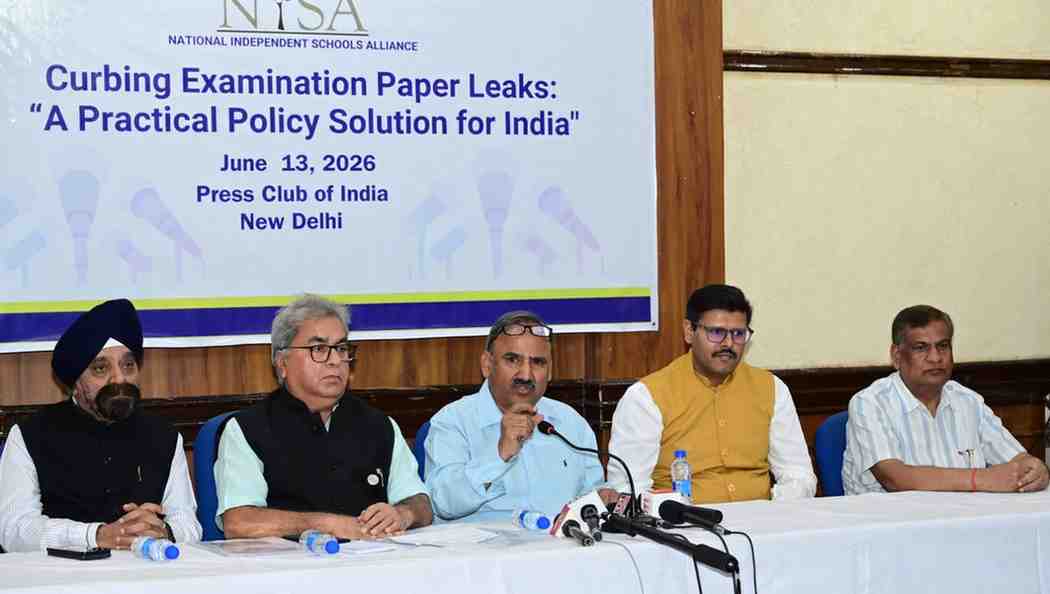
Addressing a press conference at the Press Club in New Delhi on Saturday, NISA National President Dr. Kulbhushan Sharma argued that one of the underlying causes of examination-related malpractices is the declining significance of Class 12 Board Examination scores in higher education admissions.
According to Dr. Sharma, admission to many prestigious professional courses now depends largely on entrance examinations, while Class 12 Board results carry limited weight. This trend, he said, has encouraged students to enroll in dummy schools and dedicate most of their time to coaching centres rather than regular classroom education.
He observed that the coaching industry has expanded rapidly over the years and now operates on a financial scale comparable to significant segments of the formal education sector. Dr. Sharma warned that the enormous commercial interests associated with coaching institutes create opportunities for unethical practices and increase the risk of examination-related irregularities.
Commenting on public reactions following paper leak incidents, Dr. Sharma said demands for ministerial resignations or disciplinary action against officials may satisfy immediate public sentiment but do not address the root causes of the problem. He stressed that long-term solutions require comprehensive policy reforms aimed at strengthening examination systems and reducing vulnerabilities.
NISA also highlighted concerns regarding governance within the Central Board of Secondary Education (CBSE). Joint Secretary Dr. Dilip Modi stated that CBSE, as a national board, should ensure broader representation from schools across different states and regions of India. He argued that wider participation in decision-making would help create policies that better reflect the needs of schools nationwide.
Dr. Modi further referred to the Coaching Guidelines 2024 introduced by the Government to regulate coaching institutions. While welcoming the initiative, he noted that implementation remains inadequate. He urged authorities to enforce the guidelines effectively across the country to ensure greater accountability and oversight within the coaching sector.
The alliance reiterated that examination reforms should focus on transparency, credibility, and fairness. It appealed directly to Prime Minister Narendra Modi to constitute a National Examination Reform Commission that could undertake a comprehensive review of the examination ecosystem and recommend measures to prevent future paper leaks.
Several NISA office-bearers, including Lakshya Chhabadia, Devender Arora, and Kodaram, were also present during the press conference and supported the demand for systemic reforms in the education and examination framework.
NISA’s proposal highlights a broader debate about the growing dominance of entrance examinations and the coaching industry in India. By linking paper leaks to the reduced importance of Class 12 Board examinations, the organisation has shifted the discussion from administrative failures to structural weaknesses in the education system.
While stricter security measures remain essential, the call for a National Examination Reform Commission suggests that sustainable solutions may require a re-evaluation of admission policies, stronger regulation of coaching institutes, and greater integration of school education with higher education admissions.
If implemented thoughtfully, such reforms could help reduce excessive dependence on coaching centres and strengthen trust in India’s examination process.