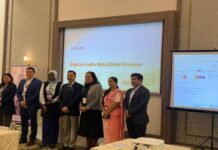
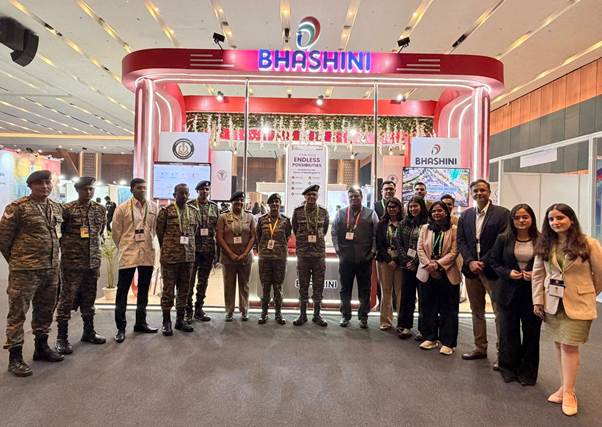
BHASHINI, India’s indigenous multilingual AI platform, is emerging as a powerful tool for transforming healthcare delivery, reducing doctors’ documentation workloads and helping patients communicate in their preferred languages. At the Global Digital Health Summit (GDHS) 2026 in New Delhi, BHASHINI showcased innovative multilingual AI applications designed to make healthcare more accessible, efficient and inclusive.
The Digital India BHASHINI Division (DIBD), operating under Digital India Corporation (DIC) and the Ministry of Electronics and Information Technology (MeitY), demonstrated how speech recognition, translation and voice-based technologies can improve medical workflows across major healthcare institutions, including AIIMS, JIPMER and the Indian Army’s Directorate General of Medical Services.
The two-day summit was held at Bharat Mandapam on November 20 and 21, 2026, under the theme “Implementing Artificial Intelligence – AI in Action.”
BHASHINI Brings Multilingual AI to Healthcare
BHASHINI’s participation highlighted the growing role of artificial intelligence in addressing language barriers within India’s diverse healthcare ecosystem. Its exhibition featured practical demonstrations of speech-to-text, text-to-speech, multilingual translation and voice-enabled medical documentation.
The technology is designed to help healthcare professionals record patient information more efficiently while enabling better communication between doctors and patients who speak different languages.
The demonstrations showcased how indigenous language AI solutions can be integrated into existing hospital systems rather than requiring healthcare institutions to completely overhaul their digital infrastructure.
AIIMS Introduces Voice-Based Prescription Technology
At the All India Institute of Medical Sciences (AIIMS), New Delhi, BHASHINI’s speech-to-text technology has been integrated with the prescription module of NIC’s eHospital platform. The system allows doctors to dictate prescriptions instead of manually typing them, helping save time during consultations and reducing the burden of repetitive documentation.
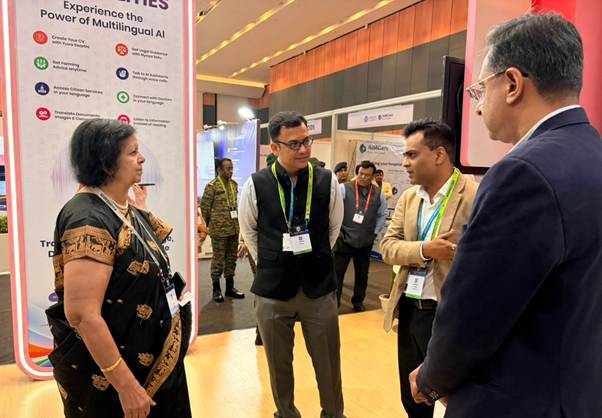
The technology was initially piloted in the Neurology and Neurosurgery departments, where doctors reportedly provided positive feedback. Following the encouraging experience, the application is now being expanded across the institute.
The integration is expected to support doctors in busy outpatient departments (OPDs), where faster documentation can help improve workflow efficiency and allow medical professionals to devote more attention to patient care.
JIPMER Integrates e-BHASHINI With e-Sushrut HMIS
The Jawaharlal Institute of Postgraduate Medical Education and Research (JIPMER) showcased its integration of e-BHASHINI with e-Sushrut, its Hospital Management Information System (HMIS).
The technology enables doctors to use voice commands in English and supported Indian languages to document clinical information. Applications include recording patient case histories during outpatient consultations, preparing inpatient department (IPD) notes and generating discharge instructions.
By converting spoken medical information into digital documentation, the platform aims to reduce administrative workload and improve the efficiency of clinical operations.
JIPMER’s initiative also highlights the potential of multilingual AI to make public healthcare more patient-centric, particularly for people who may struggle to communicate medical concerns in languages unfamiliar to healthcare providers.
Indian Army Demonstrates AI-Powered Medical Documentation
The Directorate General of Medical Services (Army) presented its implementation of BHASHINI technology within the Dhanwantri healthcare platform. The system converts doctors’ spoken clinical notes into typed text, supporting voice-based medical documentation and helping medical professionals save valuable time.
Also Read | Trump Arrives In China For Historic Xi-Putin Summit: Nuclear War, Ukraine Crisis At Stake
The technology is particularly relevant for the Indian Army’s healthcare network, which serves serving personnel, retired servicemen, veterans and their families from different regions and linguistic backgrounds.
Maj Gen Sandeep Bhalla, ADGMS (IS, H & PS), said multilingual support was essential for an organisation serving people from diverse cultural and linguistic communities.
He highlighted that BHASHINI’s speech-to-text technology could improve doctors’ efficiency while helping patients communicate in their preferred language, making consultations more comfortable and medical advice easier to understand.
Shrutlekh and Other Language AI Innovations
The summit also featured Shrutlekh, BHASHINI’s speech-to-text technology, which demonstrated real-time multilingual transcription and translation capabilities during summit sessions.
Other platforms showcased included the BHASHINI mobile application, offering translation and voice-based features for users, and Data Daan, which encourages community participation in contributing language data to strengthen India’s AI ecosystem.
Granthika, another platform presented at the exhibition, supports the collection and digitisation of written and spoken language resources, helping expand the availability of linguistic data for AI development.
India’s Multilingual AI Push Gains Momentum
BHASHINI currently supports 36 Indian text languages, 23 Indian voice languages and 35 international languages. Its technology ecosystem includes translation, speech recognition, speech synthesis, transliteration and other language-based services.
According to the organisation, its platform has recorded more than 11 billion AI inferences, processing approximately 24 million inferences daily, reflecting the increasing adoption of multilingual digital technologies.
Through its participation in GDHS 2026, BHASHINI underscored India’s ambition to use homegrown AI technologies to improve healthcare delivery, strengthen digital inclusion and ensure that language does not become an obstacle to accessing essential medical services.
The initiatives showcased by AIIMS, JIPMER and the Indian Army demonstrate how multilingual AI could become an important part of India’s evolving digital healthcare infrastructure, bringing technology closer to doctors and patients alike.
Click here to join our WhatsApp Channel for real-time news updates and exclusive coverage.