

Italy is preparing a major overhaul of school integration rules, with Prime Minister Giorgia Meloni announcing plans to restrict the wearing of face-covering Islamic veils in schools and establish a legal limit on the number of foreign students allowed in individual classrooms.
The proposed measures, announced by Meloni on Sunday, September 20, 2026, are expected to be presented to Italy’s Council of Ministers. The package would also introduce compulsory Italian-language learning for parents of foreign students experiencing serious difficulties integrating into the education system.
The announcement has placed immigration, education, language integration and religious expression at the centre of Italy’s political debate, particularly as the government moves toward new rules governing multicultural classrooms.
Meloni Announces New School Integration Measures
Speaking at Fenix, a national festival organised by the youth wing of her Brothers of Italy party in Rome, Meloni said the government would establish a maximum number of foreign students permitted in each class.
She argued that integration becomes more difficult when large numbers of students are unable to communicate effectively in Italian. According to Reuters, Meloni said that a single student struggling with the language could potentially integrate with assistance from teachers and classmates, but argued that a large concentration of students facing language barriers presents a different challenge.
Meloni also said children born or raised in Italy should not feel marginalised in their own classrooms. She linked the proposed measures to her broader emphasis on language learning, cultural understanding and compliance with Italian laws.
Proposed Ban Targets Full-Face Coverings
The planned school restrictions have also drawn attention because of their impact on religious clothing.
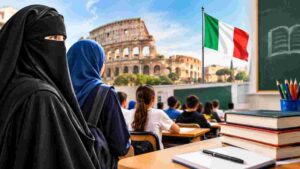
Meloni specifically referred to the burqa and niqab, both of which cover the face. The burqa generally covers the entire body and face, while the niqab covers the face while leaving the eyes visible.
AP reported that Meloni did not specifically mention the hijab in her announcement. The hijab normally covers the hair and neck but leaves the face visible. However, ANSA reported Meloni as referring to a prohibition on the burqa and hijab in schools. The precise scope of the proposal will therefore become clearer when the government formally releases the legislative text.
Meloni said students should attend school with their faces uncovered and argued that no tradition should require a young woman to conceal herself in an Italian classroom.
Foreign Student Cap Still Undisclosed
Although the government has announced plans for a legal ceiling on foreign students per classroom, no specific percentage or numerical limit has yet been officially disclosed.
The issue is significant because Italy has a substantial population of students holding non-Italian citizenship. Data from Fondazione ISMU, based on Istat information, show that 931,323 students with non-Italian citizenship were enrolled in Italian schools during the 2024–25 academic year. They represented 11.6% of the country’s total school population.
Also Read | Trump’s China Shift: 5 Reasons His Tough Stance On Xi Is Suddenly Softening
The proportion varies across different stages of education. According to the same data, students with non-Italian citizenship accounted for 13.7% of pupils in primary schools, 12.7% in preschool and 12.6% in lower secondary education, while the share was below 9% in upper secondary schools.
Italian Lessons Planned for Some Parents
Another significant element of the proposal is a language requirement for parents.
Meloni said parents of foreign students experiencing serious difficulties integrating into the school system would be required to learn Italian. The government has presented language acquisition as an important part of helping families navigate Italian education and society.
The proposal comes amid wider discussions across Europe over migration, integration and the role of religious symbols in public institutions.
Italy Joins Wider European Debate
Italy’s planned restrictions come as several European countries already have laws limiting face-covering clothing in public places or specific institutions.
France and Belgium have broad restrictions on face coverings in public, while Denmark and Austria have also adopted measures concerning face-covering garments. Switzerland introduced a nationwide face-covering ban in 2025. Rules differ considerably between countries and often distinguish between full-face coverings such as the niqab and burqa and headscarves such as the hijab.
Italy’s proposal will now move toward the formal legislative process. If approved by the government, the measure would still require parliamentary approval before becoming law. AP reported that government-approved legislation would need parliamentary ratification within 60 days under the procedure described.
The final wording of the legislation, including the precise definition of prohibited garments and the numerical limit for foreign students, is therefore expected to be closely watched in Italy and across Europe.
Click here to join our WhatsApp Channel for real-time news updates and exclusive coverage.