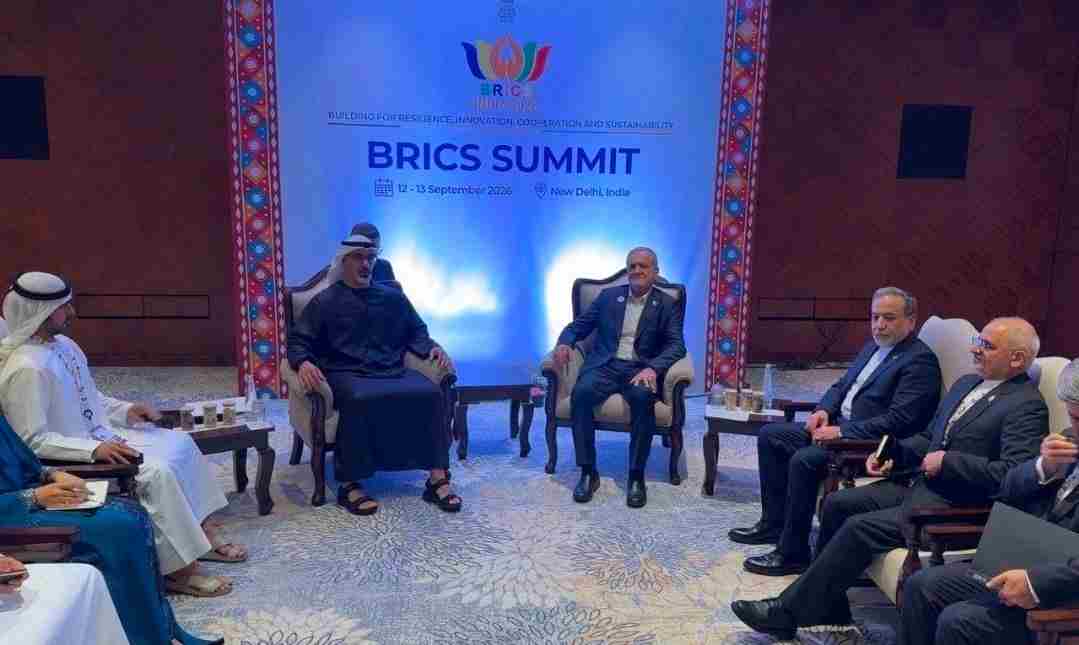
Iranian President Masoud Pezeshkian has indicated that Tehran and Abu Dhabi are seeking a fresh start in relations, saying the two sides want to “turn the page” and focus on building a future together. His comments came a day after he held a high-level meeting with Abu Dhabi Crown Prince Sheikh Khaled bin Mohamed bin Zayed Al Nahyan on the sidelines of the BRICS Summit in New Delhi.
The meeting marked an important diplomatic contact between Iran and the United Arab Emirates at a time when relations have faced severe pressure following the escalation of the West Asia conflict. Pezeshkian described his exchange with the Crown Prince as constructive, suggesting that both countries see value in reopening channels of dialogue despite recent tensions.
Pezeshkian Signals A New Chapter With UAE
Pezeshkian said the meeting represented the first constructive exchange with the Abu Dhabi Crown Prince since the war and incidents in the Persian Gulf. He said the two sides had agreed to move beyond the difficulties of the past and concentrate on what lies ahead.
“It was agreed that we would turn the page, look to the future and build it together,” Pezeshkian was quoted as saying by AFP.
The statement carries significance because Iran-UAE relations have become increasingly complicated amid the broader regional conflict. Tehran and several Gulf countries have been navigating heightened security concerns, economic uncertainty and the possibility of further escalation.
Pezeshkian’s remarks therefore point towards an attempt to prevent the recent crisis from permanently damaging relations between Iran and the UAE.
Landmark Meeting At BRICS Summit In New Delhi
Pezeshkian and Sheikh Khaled met during the first day of the BRICS Summit in New Delhi. The encounter was described as the highest-level meeting between Iran and the UAE since the beginning of the West Asia conflict.
According to the Abu Dhabi Media Office, the discussions covered regional and international developments, efforts toward de-escalation, stability and initiatives aimed at supporting peace and development in the region.
No detailed bilateral agreement was announced following the meeting. However, the decision by the two leaders to engage directly at a major international gathering was viewed as an important diplomatic development.
The timing was also notable because Iran and the UAE had joined other BRICS countries in issuing a joint statement calling for restraint amid the continuing conflict in West Asia.
Iran-UAE Ties Under Pressure After West Asia War
Relations between Tehran and Abu Dhabi have come under significant strain since the conflict intensified. The escalation followed US-Israeli attacks on Iran in February, after which Tehran launched strikes against US allies in the region.

The UAE subsequently faced the impact of the wider conflict and, in August, announced the suspension of trade and financial exchanges with Iran.
Against this backdrop, Pezeshkian’s call for a new beginning could be an attempt to rebuild a degree of diplomatic confidence between the two countries.
Iran and the UAE have longstanding economic connections, making the relationship particularly important for both sides. Dubai has a well-established Iranian community and has historically played a significant role in Iran’s commercial links with the outside world, particularly as Tehran continues to face international sanctions.
BRICS Provides Diplomatic Platform
The BRICS Summit in New Delhi offered Iran and the UAE an opportunity to engage within a wider multilateral setting. Both countries are members of the expanded BRICS grouping, giving them a common diplomatic platform despite their differences.
Also Read — India Condemns Oman Ship Attack As 13 Indian Seafarers Rescued, One Missing
The joint BRICS statement urging restraint in the West Asia conflict added another layer to the discussions surrounding the bilateral meeting. The declaration reflected concerns about the continuing escalation and the need for greater stability across the region.
For Tehran and Abu Dhabi, maintaining diplomatic communication could become increasingly important as regional tensions affect security, trade and economic activity.
Gulf Security And Strait Of Hormuz Concerns
The wider conflict has also intensified international attention on Gulf security and the Strait of Hormuz, one of the world’s most strategically important energy routes.
Any prolonged instability in the region could create risks for international shipping, energy supplies and global markets. Gulf states therefore have a strong interest in preventing further escalation and maintaining channels through which disputes can be addressed.
BSF’s Timely Rescue Saves 10 Bangladeshis, Including 30-Day-Old Infant, After Ganga Boat Capsizes
The Pezeshkian-Sheikh Khaled meeting comes against this broader backdrop of regional uncertainty, making its emphasis on de-escalation and future cooperation particularly significant.
Trump Comments On Iran-Gulf Meeting
The diplomatic developments came as US President Donald Trump commented on a proposed meeting between Iran and Gulf countries concerning the Strait of Hormuz.
Trump said he did not “care” about the proposed meeting, telling reporters during a visit to Ireland that the decision was up to the countries involved. The meeting was reportedly planned to take place in Oman on Monday.
His comments underline the complicated diplomatic environment surrounding Iran, the Gulf states and the United States.
What The Iran-UAE Reset Could Mean
Pezeshkian’s “turn the page” message does not by itself guarantee a full restoration of Iran-UAE relations. The two countries still face substantial challenges, particularly those arising from the ongoing regional conflict and its economic consequences.
However, the direct meeting between the Iranian president and Abu Dhabi’s Crown Prince represents a potentially important opening for dialogue.
For Iran, stronger engagement with the UAE could help preserve vital economic and regional connections. For Abu Dhabi, maintaining communication with Tehran could support broader efforts to reduce security risks and protect regional stability.
The New Delhi meeting therefore stands out as a significant diplomatic moment during the BRICS Summit. Whether the pledge to “turn the page” develops into sustained engagement will depend on what follows in the coming weeks, but Pezeshkian’s message signals that Tehran is prepared to explore a more cooperative path with Abu Dhabi.
Click here to join our WhatsApp Channel for real-time news updates and exclusive coverage.