
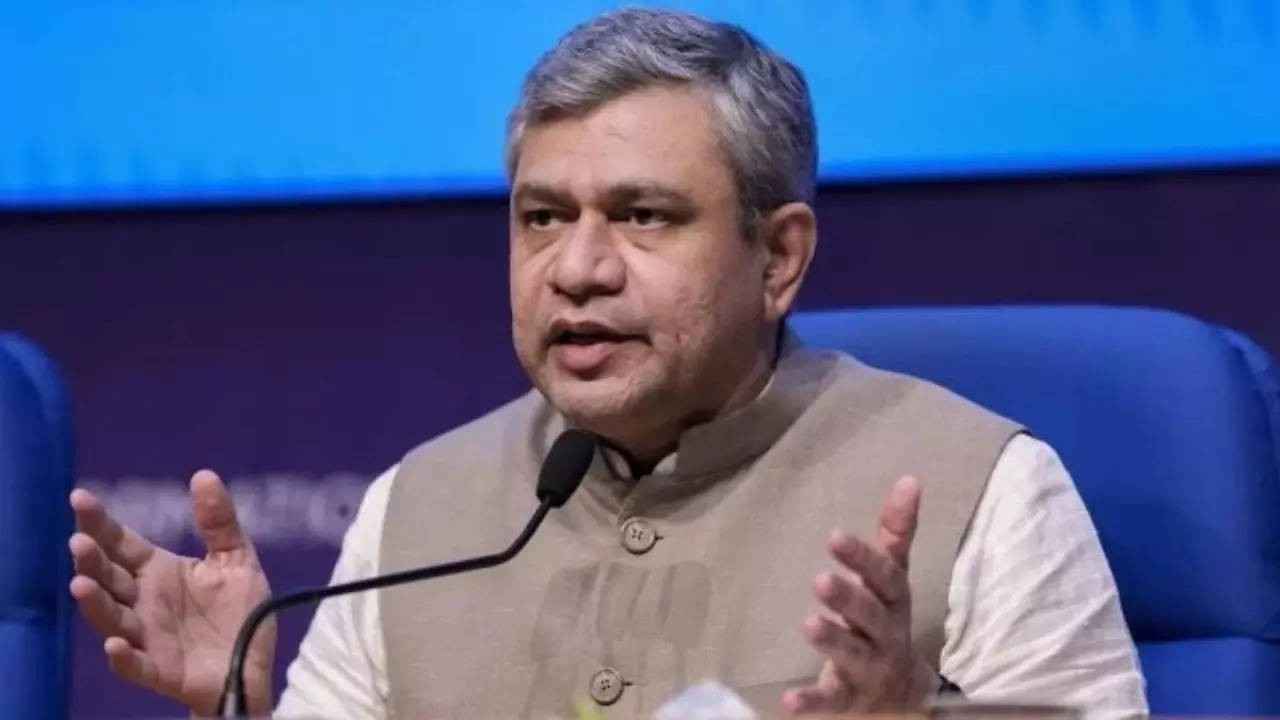
India’s space programme is increasingly being powered by indigenous semiconductor technology, with homegrown chips supporting critical missions from Chandrayaan-3 to Aditya-L1, Union Minister Ashwini Vaishnaw said on National Space Day.
The minister highlighted the country’s growing capabilities in developing advanced, space-grade semiconductor technologies, describing them as an important pillar of the country’s push towards technological self-reliance and Aatmanirbhar Bharat.
Indigenous Chips Strengthen the Space Programme
The nation’s space achievements have traditionally been associated with powerful launch vehicles, sophisticated satellites and landmark missions. However, behind these visible milestones lies another crucial layer of technology: semiconductor components capable of operating under the extreme conditions of space.
According to Vaishnaw, the Semiconductor Laboratory (SCL) in Mohali has been developing flight-grade chips for satellites and launch vehicles. These components are designed to withstand demanding environments involving radiation, extreme temperatures, pressure, acceleration and acoustic conditions.
Such technologies are particularly important because conventional commercial electronics may not be capable of reliably functioning in space. Radiation-hardened and specialised semiconductor devices can help ensure that spacecraft systems continue operating during long-duration and high-risk missions.
Chandrayaan-3 Used Indian-Made Camera Chip
One of the notable examples of indigenous semiconductor technology was the use of an Indian-made camera chip aboard the Chandrayaan-3 lander.
The chip, developed by SCL Mohali, supported the lander’s imaging systems during the historic lunar mission. Chandrayaan-3 successfully achieved a soft landing on the Moon, marking a major milestone for the space programme.
The inclusion of an Indian-developed semiconductor component in the mission demonstrates the growing depth of the country’s domestic space-electronics ecosystem.
Beyond individual missions, the development of such components can reduce dependence on imported technologies for strategically important applications.
Vikram Processor Supports Launch Vehicles
Vaishnaw also highlighted the role of SCL’s Vikram processor in India’s launch vehicles and rockets.
Processors are central to spacecraft and launch systems, where they are required to control, monitor and process information from multiple onboard systems. Developing processors specifically suited to demanding aerospace environments represents a significant technological capability.
The use of indigenous processors and other specialised electronics strengthens the domestic supply chain supporting India’s launch infrastructure.
Aditya-L1 Powered by Radiation-Hardened Technology
India’s semiconductor capabilities are also supporting missions beyond the Moon.
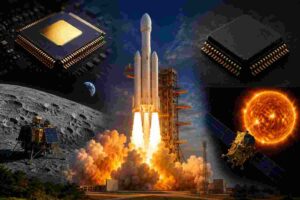
The Aditya-L1 solar mission, designed to study the Sun and its influence on space weather, uses radiation-hardened analogue-to-digital converter (ADC) chips developed by SCL.
The mission operates in an environment where spacecraft electronics must withstand significant radiation exposure. Radiation-hardened components are therefore critical for maintaining the reliability of scientific instruments and onboard systems.
The use of domestically developed ADC technology highlights how India’s semiconductor expertise is extending into increasingly sophisticated scientific missions.
From the Moon to the Sun
India’s progress in space-grade semiconductor technology reflects a broader transformation in the country’s approach to strategic technology.
From imaging systems and processors to sensors and specialised integrated circuits, indigenous components are increasingly becoming part of the technological foundation of India’s space missions.
SCL has developed several categories of specialised devices, including radiation-hardened chips, pressure and acceleration sensors, temperature and acoustic sensors, electro-optical CCD and CMOS imagers, as well as custom application-specific integrated circuits (ASICs).
These technologies can support spacecraft, launch vehicles and scientific instruments operating in challenging environments.
Aatmanirbhar Bharat Gains Momentum
Vaishnaw linked these developments to Prime Minister Narendra Modi’s emphasis on technological self-reliance.
The expansion of domestic semiconductor capabilities is viewed as an important component of the broader Aatmanirbhar Bharat vision, particularly in sectors where technology security and supply-chain resilience are strategically important.
For India’s space sector, indigenous semiconductor production can provide greater control over critical components while supporting innovation within the domestic aerospace and electronics ecosystem.
It can also create opportunities for research institutions, semiconductor laboratories, startups and private-sector manufacturers to participate in the development of next-generation space technologies.
Critical Technology for Future Missions
As India prepares for increasingly ambitious space missions, the importance of reliable indigenous electronics is expected to grow.
Future missions will demand advanced computing, sensing, imaging and communication systems capable of operating for extended periods in harsh environments. Space-grade semiconductor technologies will therefore remain central to the country’s ambitions.
Also Read: Jaish-e-Mohammed Rebuilds Bahawalpur Terror Base, 15 Months After Operation Sindoor
The country’s growing ability to design and develop such components domestically represents more than a manufacturing achievement. It strengthens the technological foundation required for sustained exploration and scientific discovery.
India’s Space Journey Enters a New Phase
National Space Day offers an opportunity to celebrate India’s achievements in space while recognising the less visible technologies that make those achievements possible.
From Chandrayaan-3’s lunar mission to Aditya-L1’s study of the Sun, Indian-made semiconductor technologies are increasingly contributing to the country’s space capabilities.
Vaishnaw’s remarks underline a broader message: India’s journey into space is being accompanied by a parallel journey towards technological self-reliance.
As the country targets more complex missions and expands its space ambitions, made in India chips are poised to become an increasingly important part of the systems powering India’s journey from the Moon to the Sun and beyond.
Click here to join our WhatsApp Channel for real-time news updates and exclusive coverage.