
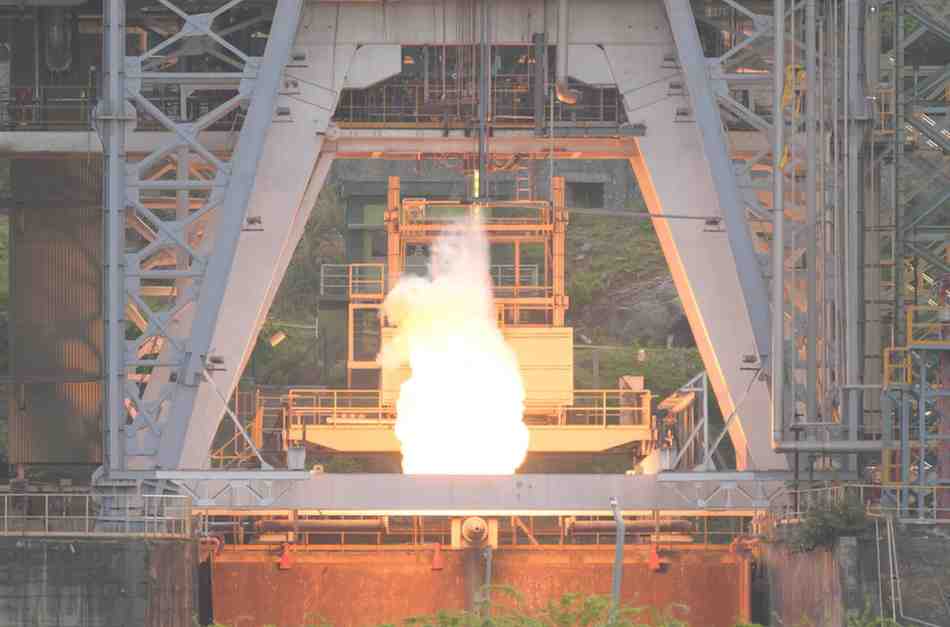
India has taken another significant step in strengthening its space programme after the Indian Space Research Organisation (ISRO) successfully completed a crucial hot test of its next-generation semi-cryogenic rocket engine. The achievement is being viewed as an important milestone in the country’s efforts to develop more powerful launch vehicles while simultaneously advancing the ambitious Gaganyaan human spaceflight mission.
Speaking in Bengaluru, ISRO Chairman V. Narayanan described the recent engine test as a major technological achievement and confirmed that preparations for Gaganyaan are progressing steadily. He reiterated that the country’s first human spaceflight programme will be preceded by three uncrewed missions before Indian astronauts are sent into orbit. Detailed launch schedules are expected to be announced after ongoing technical reviews are completed.
Successful Power Head Test
The latest breakthrough came after ISRO successfully conducted a hot test of the Semi-Cryogenic Engine Power Head Test Article (PHTA) at the ISRO Propulsion Complex in Mahendragiri, Tamil Nadu, on June 24.
During the test, engineers operated only the engine’s power head, which includes highly sophisticated turbopumps responsible for delivering fuel and oxidiser into the combustion chamber under extremely high pressure. The thrust chamber itself was intentionally excluded from the experiment, allowing scientists to independently validate the most complex part of the propulsion system before integrating the complete engine.
According to ISRO, the test generated nearly 175 tonnes of thrust—around 88 percent of the engine’s planned full capability. It represents the eighth successful trial in a series of developmental tests, following earlier runs conducted at lower thrust levels.
Why the Test Matters
Testing the power head separately enables engineers to evaluate the performance of critical components without exposing the entire engine to unnecessary risks.
The turbopumps operate under enormous pressure while handling both refined kerosene and liquid oxygen. Any malfunction in this section could affect the entire propulsion system. By validating the power head independently, ISRO can confirm the stability of fuel flow, pressure management and mechanical performance before proceeding to a full-engine hot test.
Following this successful trial, ISRO is now preparing to test the fully integrated semi-cryogenic engine, bringing the project one step closer to operational deployment.
What Makes the Semi-Cryogenic Engine Different?
Unlike conventional cryogenic engines that use both liquid hydrogen and liquid oxygen, the semi-cryogenic engine combines liquid oxygen with refined kerosene.
This configuration offers several operational advantages. Refined kerosene is easier to store and transport than liquid hydrogen, while also providing higher fuel density. The combination is expected to improve reliability, simplify launch preparations and enhance payload capability for future heavy-lift rockets.
The new propulsion system is expected to play a key role in India’s future launch vehicles, including upgrades to existing heavy-lift rockets.
Boost for Gaganyaan Programme
Alongside the engine update, ISRO also shared encouraging news regarding the Gaganyaan mission.
Chairman Narayanan confirmed that India remains committed to carrying out three uncrewed demonstration missions before launching astronauts into space. These missions will thoroughly validate the spacecraft, launch vehicle, life-support systems, crew safety mechanisms and recovery operations before the first crewed flight is approved.
The cautious step-by-step approach reflects ISRO’s emphasis on mission safety and reliability, ensuring every system undergoes extensive testing before human participation.
Strengthening India’s Space Capabilities
The semi-cryogenic engine is expected to become a major component of India’s future launch infrastructure. Once fully operational, it could replace older propulsion systems used in the core stages of heavy-lift launch vehicles, allowing them to carry heavier satellites, deep-space missions and human spaceflight payloads more efficiently.
The development also supports India’s broader long-term space roadmap, which includes an indigenous space station, advanced lunar missions and eventually sending an Indian astronaut to the Moon.
Indigenous Technology Success
Narayanan also highlighted India’s success in mastering advanced propulsion technologies that were once inaccessible because of international technology restrictions.
Over the years, ISRO has developed indigenous cryogenic propulsion systems and continues to expand its expertise with semi-cryogenic technology, reducing dependence on foreign technologies while strengthening India’s position among leading spacefaring nations.
Road Ahead
With the successful power head test completed, ISRO will now focus on full-engine qualification and subsequent integration into future launch vehicles. Simultaneously, preparations for Gaganyaan’s uncrewed missions continue, with launch dates expected to be announced once final reviews are completed.
The latest achievement demonstrates steady progress in India’s pursuit of advanced rocket propulsion and human spaceflight. As ISRO advances both technologies in parallel, the country moves closer to achieving several ambitious milestones that will define the next phase of its space exploration programme.