
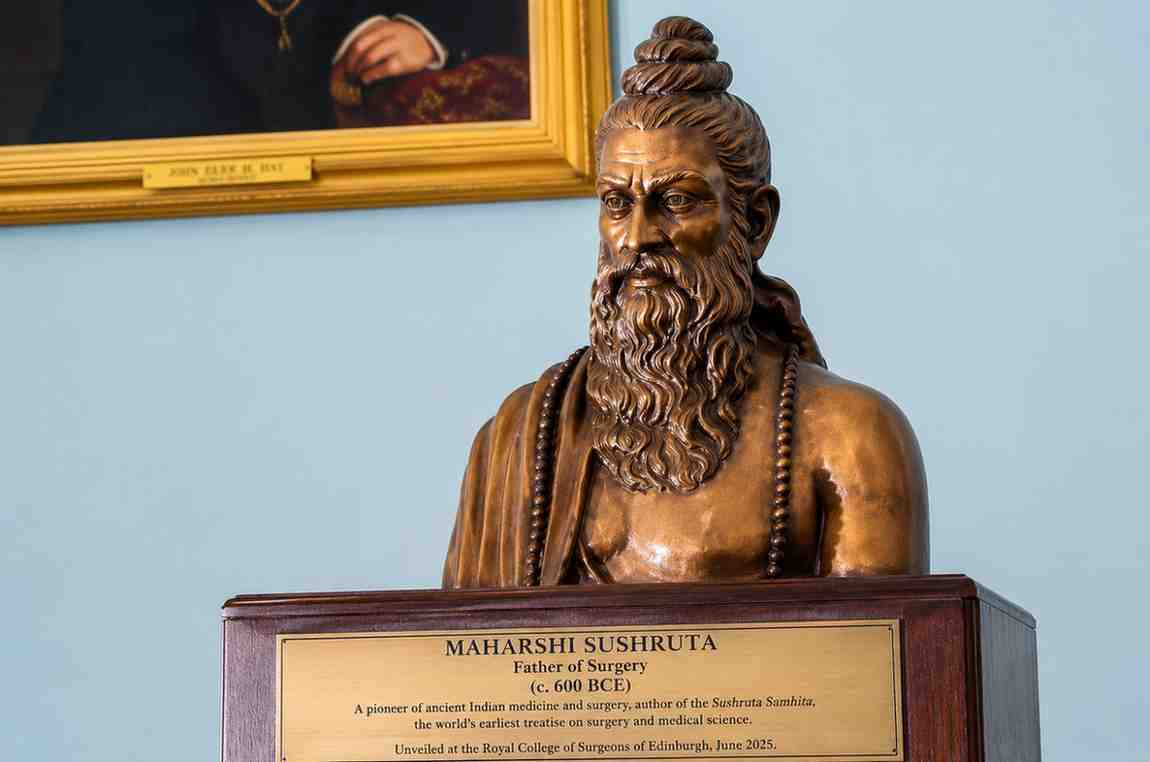
The unveiling of a bronze statue of Maharshi Sushruta at the historic Royal College of Surgeons of Edinburgh has triggered an international debate about the recognition of ancient Indian contributions to modern medicine and surgery.
The event, held on June 19 in Scotland, has drawn attention from academics, historians, surgeons and policymakers worldwide, with many hailing it as a significant acknowledgment of India’s scientific heritage.
Historic Recognition for Ancient Indian Knowledge
Maharshi Sushruta is widely regarded as one of the earliest pioneers of surgery. He is believed to have lived around 600 BCE and authored the famous Sanskrit medical text, the Sushruta Samhita.
The medical treatise is considered among the world’s oldest surgical manuals and contains detailed descriptions of surgical procedures, anatomy, instruments, wound management and reconstructive techniques. Historians and medical scholars often describe him as the “Father of Surgery” due to his remarkable contributions to surgical science.
Statue Installed at Prestigious Surgical Institution
The bronze statue, weighing approximately 90 kilograms, was installed inside the Playfair Auditorium of the Royal College of Surgeons of Edinburgh, one of the world’s oldest surgical institutions established in 1505.
The initiative was supported by the Cheruvu Family Foundation, founded by UK-based surgeon Professor Chandra Cheruvu and his family. The sculpture was crafted by an artist from Tamil Nadu, symbolising a collaborative effort between Indian cultural heritage and international medical institutions.
The ceremony was attended by several dignitaries, including Siddharth Malik, medical experts and representatives from both Indian and British institutions.
Why the Statue Has Triggered Debate
The installation has reignited discussions about whether ancient Indian scientific achievements have historically been overlooked in mainstream global narratives.
Supporters argue that India’s contributions to medicine, mathematics, astronomy and philosophy have often been underrepresented in international education systems.
They say the recognition of Sushruta at a globally respected institution is an important step toward acknowledging non-Western scientific traditions.
At the same time, some scholars have called for maintaining a distinction between cultural pride and historical evidence, emphasizing that ancient achievements should continue to be evaluated through rigorous academic research.
The debate has largely centered on balancing national heritage with evidence-based historical scholarship.
Sushruta’s Surgical Contributions
Medical historians point out that the Sushruta Samhita described more than 300 surgical procedures and around 120 surgical instruments centuries before many modern medical advancements.
The text also discussed:
- Cataract surgery techniques
- Reconstructive and plastic surgery procedures
- Bone fracture management
- Childbirth-related interventions
- Anatomy and dissection practices
- Medical ethics and physician training
One of Sushruta’s most frequently cited innovations is rhinoplasty, a reconstructive nose surgery technique that later influenced developments in plastic surgery worldwide.
Growing Global Interest in Traditional Knowledge
The Edinburgh recognition comes at a time when there is increasing global interest in traditional systems of medicine and historical scientific knowledge.
Educational institutions worldwide have begun exploring ancient knowledge systems more systematically, integrating interdisciplinary research between historians, physicians and scientists.
Experts say such initiatives can encourage a broader understanding of how civilizations across the world contributed to humanity’s collective scientific progress.
However, they also caution against oversimplification or exaggeration, stressing that historical contributions should be celebrated responsibly and backed by documented evidence.
India’s Soft Power on the Global Stage
The event is also being viewed through the lens of cultural diplomacy.
India has increasingly promoted its ancient heritage internationally through initiatives involving yoga, Ayurveda, traditional medicine and cultural exchanges.
The recognition of Sushruta by a prestigious global institution strengthens India’s efforts to showcase its historical contributions beyond cultural and spiritual domains, extending into science and medicine.
Observers believe such acknowledgments can foster deeper academic collaborations between Indian and international institutions in the future.
Looking Ahead
The Sushruta statue in Edinburgh is more than a symbolic installation. It represents a growing movement to reassess world history through a more inclusive lens that acknowledges contributions from multiple civilizations.
As debates continue, experts agree on one point: scientific history becomes richer when diverse traditions are studied, verified and integrated into global narratives.
For many, the statue stands not only as a tribute to an ancient physician but also as a reminder that knowledge has always been a shared human endeavor that transcends geographical boundaries.